
Articles - Couplers

This page provides a bit of a history of the American Flyer S-scale couplers' evolution, and which couplers modelers with original A.C. Gilbert American Flyer equipment are using today.
A.C. Gilbert Non-operating Couplers
The original A.C. Gilbert American Flyer solid, non-operating couplers were generally produced from 1958 to 1960, and were used on uncataloged sets and, in a very few cases, on some low-priced cataloged sets. For years, the general rule was that, if the car number ended in a zero, then it had solid, non-operating couplers (of course, to every rule there are exceptions).
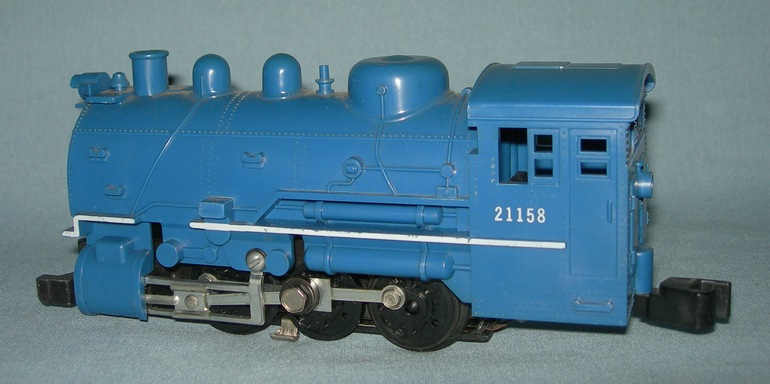
A.F. #21158, shown below, is an uncataloged 0-6-0T Docksider Switcher from 1960. Its front coupler is a non-operating, solid coupler.
copyright © Ted Hamler; used by permission
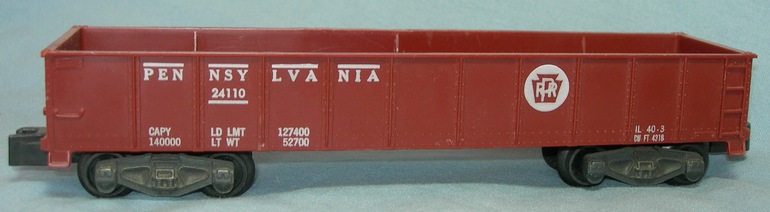
A.F. #24110, shown below, is a 1959 uncataloged Pennsylvania Railroad gondola, which has two solid, non-operating couplers.
copyright © Ted Hamler; used by permission
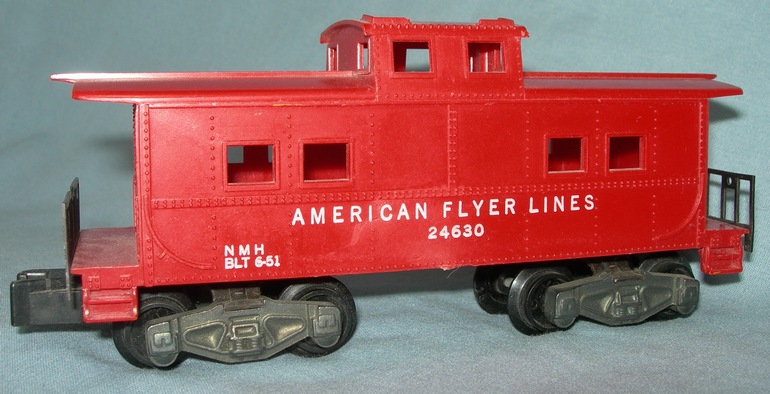
A.F. #24630, shown below, is what American Flyer collectors call a "Bobtail" caboose, meaning it only has a coupler on one end. In all, there were only five Bobtail AF cabooses produced: #938, #24627, #24630, #24631, and #24632.
copyright © Ted Hamler; used by permission
You will find these couplers in collectors' display cabinets, and on the secondary markets, but these are no longer actively manufactured or sold with new equipment. If you are interested in collecting original American Flyer equipment, this is a listing of all the A.F. items produced with solid, non-operating couplers:
A.F. #
Description
21158
1960 0-6-0T Dockside Switcher (shown above)
21161
1960 Prestone Car Care Express 4-4-2 Atlantic steam engine
24106
1960 Pennsylvania gondola
24110
1959 Pennsylvania gondola (shown above)
24130
1960 Pennsylvania gondola
24309
1957-58 Gulf Oil tank car
24310
1960 Gulf Oil single-dome tank car
24320
1960 Deep Rock single-dome tank car
24321
1959 Deep Rock tank car
24325
1960 Gulf Oil single-dome tank car
24420
1958 "Simmons Carload" reefer
24540
1960 New Haven Purity flat car, cardboard pipes
24603
1957-58 American Flyer Lines caboose
24610
1958 American Flyer Lines caboose (non-lighted)
24630
1960 American Flyer Lines caboose (non-lighted; shown above)
(281)88
1959 4-4-0 Franklin "Fifty Years of Progress in RR" display model
As mentioned above, A.F. items ending with a zero in their product number have solid, non-operating couplers. Here is a list of the exceptions:
A.F. #
Description
24030
1960 Uncataloged MKT box car (Pike-Master; part of Prestone set with #21160 engine)
24060
1963-64 M&StL box car (Pike-Master)
24230
1961-64 Peabody hopper (Pike-Master)
24550
1959-64 Monon flat car
24720
1959-61 FY&P RR coach
24730
1959-61 FY&P RR Overland baggage
24740
1960 Baggage Express combination car
24750
1960-61 FY&P RR combination car
A.C. Gilbert Link Couplers
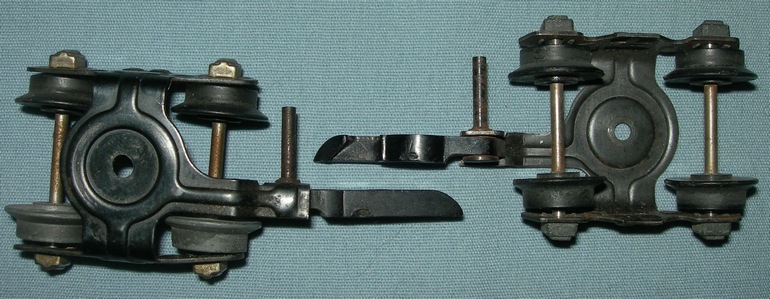
Below is a photo of the top and bottom view of a 1946 thin-shank link coupler. The shank is reduced to 1/8" in thickness at the point it attaches to the truck (by means of the link pin). The link bar on the 1946 coupler is typically black, and Gilbert utilized a circular crimping method to connect the link bar to the truck assembly.
copyright © Ted Hamler; used by permission
Below is a photo of the top and bottom view of a 1947 thick-shank link coupler. The shank maintains its uniform thickness of 1/4". In 1947 the shank thickness was increased as the 1946 version experienced a high rate of breakage. To solve the problem, Gilbert elected to increase the shank thickness, which meant that the link bar itself had to be increased as well. The link bar on 1947 is typically silver in appearance, and Gilbert utilized a star crimping method to connect the link bar to the truck assembly.
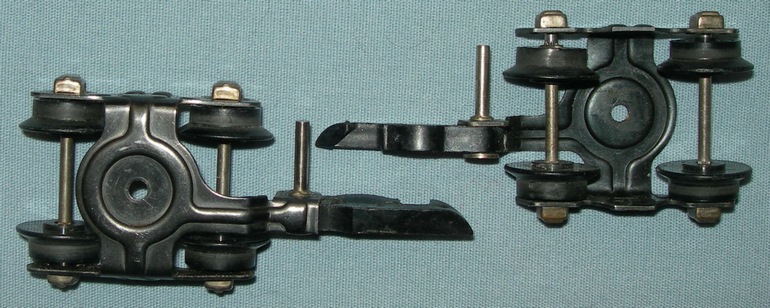
copyright © Ted Hamler; used by permission
Below is a photo of the top and bottom view of a 1948 thick-shank link coupler with a brass weight. The 1948 model is the same as the 1947 model except for the addition of that weight. After correcting the breakage problem in 1947, Gilbert was faced with the problem of cars uncoupling. The weight assisted in keeping the link coupler in the down position to eliminate the uncoupling.
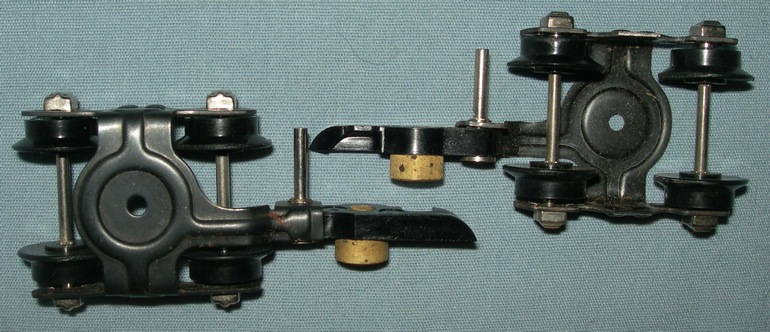
copyright © Ted Hamler; used by permission
Below is a photo of the top and bottom view of the thick-shank link couplers in use from 1949 to 1953. These have the blackened steel weight. They were identical to the 1948 model, except that the steel weight was cheaper than the brass one used in 1948. Knowing the differences in these four types of couplers is a one way of dating early American Flyer locomotives and rolling stock. Many collectors believe that in 1953 the "link coupler" era was over. By 1953 Gilbert had converted a major part of their line to the newer knuckle couplers but still offered link couplers on a couple of lower priced sets and some leftover stock.
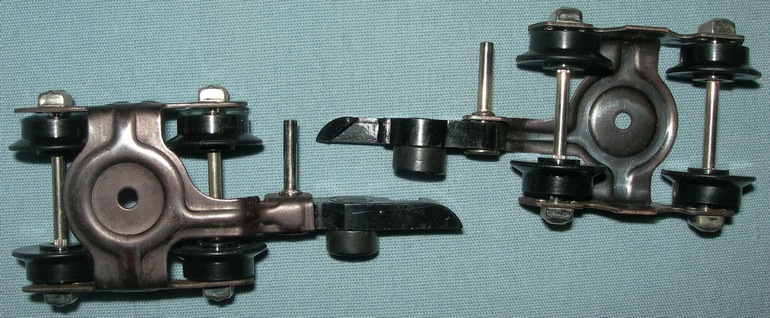
copyright © Ted Hamler; used by permission
Here is a close-up of the link pins used in the above-mentioned couplers. These were used from 1946 through 1953.
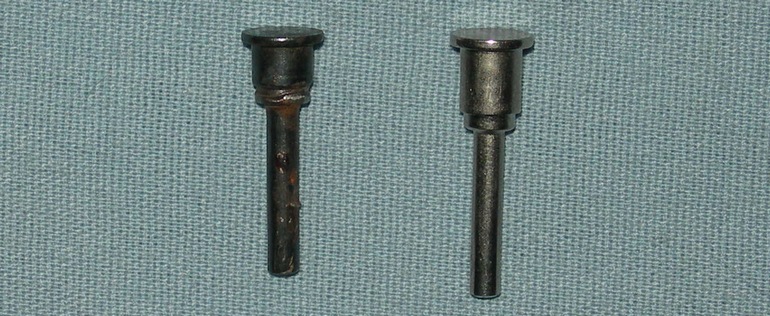
copyright © Ted Hamler; used by permission
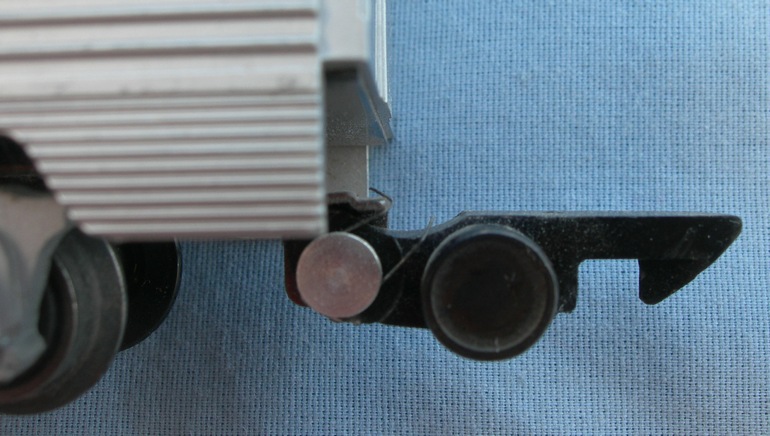
After adding weights to the couplers in 1948 that solved many of the problems with lighter and smaller freight cars, some issues still existed with longer and heavier items such as passenger cars and some Alco locomotives. So, in 1952, Gilbert created what they called a "spring assist coupler", shown below. A small spring was attached to the coupler and link bar to assist in holding the coupler in the down position. In 1952, all of the 500-series cars plus the cars in the #5205W Silver Streak set, including the #405, were equipped with this coupler. A few Santa Fe #306/361 and #360/364 Alcos have also been reported with this style coupler.
copyright © Ted Hamler; used by permission
A YouTube video about how to get link couplers to be operational again.
A.C. Gilbert Knuckle Couplers
If you have any familiarity with American Flyer at all, you will have undoubtedly seen the "knuckle coupler" (a.k.a. "claw" coupler). Some S-scale manufacturers, such as Lionel and M.T.H. manufacture their equipment with the "A.F.-compatible" coupler. It is with this knuckle coupler that they claim compatibility. This allows American Flyer and hi-rail enthusiasts who operate their equipment on their layout to be able to couple both modern as well as classic S-scale equipment.
The early riveted operating coupler was introduced in 1952, as shown in the photo below on the 1952 green #931 T&P Gondola. A.C. Gilbert introduced their new knuckle coupler into their line on only two sets that had the letter "K" in the set number, and on the locomotives, to indicate these sets had the new knuckle couplers. The two sets are the K5206W, consisting of a #K326 4-6-4 NYC Hudson, #929 MP stock car, #931 T&P gondola, #925 Gulf tank car, and an American Flyer #930 caboose. The second set was the K5210W with a #K335 4-8-4 UP Northern, #931 T&P gondola, 928 C&NW flat car with a log load, a #944 wrecking crane car, and a #945 work & boom car. Note that not all of the cars and locomotives in these two sets had the riveted knuckle couplers, as sets that were produced later in 1952 had the later style knuckle couplers. The cars and locomotives in these two sets were not sold separately.
From late 1952 through 1960 knuckle couplers were officially used in great numbers, as shown on the blue #24124 B&M gondola below. However, the B&M gondola was actually produced in 1963 and 1964, which is one of a few exceptions to the basic rule that after 1960 all rolling stock came with "Pike-Master" couplers and trucks.
From 1958 through 1960 solid, non-operating knuckle couplers were offered on a total of three locomotives and twelve cars (see discussion above, and as shown on the 1959 Tuscan #24110 Pennsylvania gondola in the photo above).
The Pike-Master coupler was used from 1961 through 1966 (the last year of A.C. Gilbert), and is shown on the 1961-through-1965 light gray #24127 Monon gondola.

copyright © Ted Hamler; used by permission
Referencing the photo below from top to bottom, the knuckle coupler used on the 1952 green #931 T&P gondola. Like the early knuckle coupler, it has a split and a hole in the side of the shank to allow it to be riveted to the truck assembly. The next two coupler styles were found on cars and locomotives that were produced at the A.C. Gilbert factory. The fourth one is the solid, non-operating knuckle coupler (Gilbert part number PA15215), which was produced at the A.C. Gilbert factory between 1958 and 1960, and mainly found on uncataloged items. The split shank coupler is an A.C. Gilbert replacement coupler, often used by their repair center at the factory, or at authorized repair shops. The last one is an example of a reproduction knuckle coupler. Because of the split in this style coupler, it can also be used to replace or convert link couplers on locomotives and rolling stock, to knuckle couplers.

copyright © Ted Hamler; used by permission
Modernday A.F.-compatible Couplers
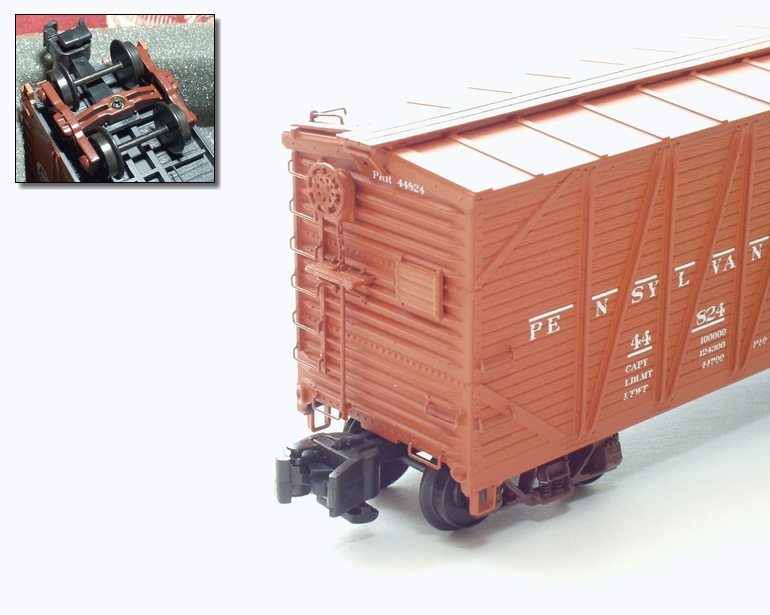
The above discussion focused on couplers that were originally produced by A.C. Gilbert. Because there are a large number of modelers who still enjoy setting up and operating their American Flyer equipment, most major S-scale manufacturers, such as American Models, Lionel, the former S-Helper Service, and M.T.H., manufacture their cars and engines with AF-compatible couplers (as shown in the photo below of an S-Helper Service box car). These couplers are truck-mounted (see inset), to allow for the tight curves that most American Flyer-based layouts have. They are backward-compatible with the original A.C. Gilbert American Flyer's operating knuckle couplers described in the previous section. If you have a traditional American Flyer or hi-rail layout, these pieces of equipment require no modification, and are ready to be used straight out of the box.
copyright © Peter Vanvliet; used by permission
Which Coupler Should I Choose?
If you enjoy operating A.C. Gilbert American Flyer equipment and you want to be able to couple to them items produced in recent years, you will need to standardize on the A.F.-compatible knuckle coupler. Port Lines Hobby Supply produces reproduction couplers, if you are interested in those.
If you are a "hi-rail" modeler, you can go either way. Some hi-rail modelers prefer the backward-compatibility and so they standardize on the knuckle coupler. Others prefer the more realistic look of the "scale" coupler.
If you still can't decide, you might want to consider a "conversion" car. This is one that has one type of coupler on one side and another on the other side. This will allow you to run your equipment in a train regardless of with which coupler the other equipment is supplied. Note that most modern-made S-scale cars, if they come with A.F.-compatible couplers, can be easily converted to "scale" couplers, should you want to go that route in the future. Older A.C. Gilbert-made equipment will require some creative work to get them to work with "scale" couplers. For more information about "scale" couplers, see our scale coupler article.