
Standard-gauge Track

Without track, we have no model railroad. This page covers what it takes to get track placed or constructed on your layout or module in S-scale. This page is restricted to only covering standard-gauge, "scale"-looking track. We have a separate page covering the original A.C. Gilbert track systems, if you are interested in that.
Rail Heights
In model railroading, the physical height of the metal rail itself is referred to as "code". This indicates the rail's height in one-thousandths of an inch. So, a piece of rail that is classified as "code 100" is 0.100 inches tall.
In the real world, railroads use weight as the rail measure. Rail sizes are indicated by the number of pounds a yard of rail weighs in North America and the UK. In the rest of the world, this is measured in kilograms per meter of rail, but it is the same concept, just different units. Either way, due to the different ways that we look at rails, there is no direct correlation or conversion factor that can be applied between prototype rail and model rail heights.
For prototype railroads, the heavier the rail is, the more expensive it is to acquire and to install. So, real railroads always look at what the lightest rail is that they can get away with in a particular stretch of track. The more trains, and/or the more weight these trains carry, the beefier the rail needs to be. For us modelers that translates into physical height of the rail. So, in general the railroads use taller/heavier rail on their main lines, and lighter rail in industrial sidings of the customer they serve. So, in S-scale, we might use code 100 to represent main line rail, code 83 for industrial sidings, and maybe even go down to code 70 for very light-use or branch-line rail.
The NMRA classifies, for S-scale, code 125 (1/8") or taller as "deep flange" or "hi-rail" track. The NMRA/NASG rail standards are covered on a different page of this web site, and it offers a table, under "RP-15.1 Rail", that translates prototype rail weights to recommended model railroading rail heights. So, if you model a specific geographical location in a specific era, you might be able to deduce which rail heights you might want to use on your layout. Of course, the rail height you choose is a personal, and possibly, artistic choice.
Unless you want or need to maintain backward compatibility with older equipment, such as A.C. Gilbert products, most S-scale modelers will use code 100 and/or code 83 rail. In general, engines and cars with older or "deep flange"/"hi-rail" wheelsets will not operate properly on "scale" track. This may be for three reasons, namely, the rail height isn't tall enough to handle the tall flanges on the wheels and so they run on the ties, the wheel tread may be too wide to properly fit within the rail spacing, and/or the distance between the flanges is too narrow to clear the guard rails on turnouts.
Conversely, engines and cars equipped with "scale" wheels should operate OK on "hi-rail" track, because the distance between that kind of track system's rails will be an acceptable distance apart. However, to accommodate the narrower spacing between the backsides of typical "hi-rail" wheels (i.e. the amount of axle space exposed between the two wheels), those track systems' turnouts will have their guides (especially the frog guard rails) too far away from the frog. This may lead to derailments for scale wheels-equipped rolling stock, as they may not be properly guided through a turnout's frog area.
If you have an existing "hi-rail" layout, but you are now "upgrading" to "scale" equipment, you can add a shim to the edges of the guard rail closest to their adjacent main rail. This will allow "scale" wheels to be properly guided through the frog area (use the NASG track standards gauge to determine how much to add). Note, however, that any "hi-rail" equipment will then no longer be able to run through those converted turnouts, unless their wheelsets are also replaced. Some modelers and some clubs will therefore have two separate loops or sections of track, to still allow both styles of equipment to be run on the same layout, just not on the same sections of track. Alternatively, you could just have a loop of track with no turnouts at all, which would then be able to accommodate all wheels.
Rail Materials
Typically, our rail is made out of nickel-silver. This is a metal alloy, typically composed of copper, nickel, and zinc. The word "silver" is only used because it has a silvery, shiny look to it, but it contains no silver. The metal alloy is used in model railroading rail, because it offers excellent electrical conductivity, and it is rust-proof (more accurately, its oxide is conductive).
The other material you might come across is brass rail. Brass rail is tougher, so it is primarily used for outdoor layouts, where it might be feasible that someone would step on the track. Brass also doesn't rust, but its electrical conductivity is not as good as nickel-silver. Nickel-silver is more easily damaged, though. Very few manufacturers still sell brass-based track components.
Track Systems
There are several companies that offer track components, snap-track, or sectional track. Some are compatible with each other, some are not. This only refers to the interconnecting system, not the rail spacing. With some clever work and hiding of the non-rail portions in ballast and scenery, various system components can be made to appear integrated.
When you are starting anew, you will want to take this into consideration as future additions to your layout may need to be compatible. Systems below are listed in alphabetical order, and we only cover brands that people typically use for more to-scale layouts.
We are now maintaining a listing of track components in the Product Gallery section of our web site, product photos are now available there.
American Models
American Models offers their track components with code 148 rail. They offer 12-inch straight sections, curved sections in various radii, 3-foot flexible track, crossings, turnouts, bumpers, and vinyl sub-roadbed. Their system does not have the plastic embedded sub-roadbed molded in. This track system is especially good if you wish to run your existing A.C. Gilbert engines and cars, or if you don't enjoy replacing wheels on that equipment.
Custom Trax
Custom Trax offers a system that has the look of hand-laid track with stained and weathered wooden ties, but yet their track goes together like sectional track. It comes with built-in ballast, so you can get going quickly. They only carry code 100 rail.
Fox Valley Models
Fox Valley Models is the newest kid on the block, starting in 2017. Why? Well, even though the owner of the company primarily sells HO- and N-scale products, he himself has an S-scale layout under construction at his home, so the company is developing an S-scale track system. Their rail is code 138. This makes the rail height, at least, compatible with the current product line of Lionel, and the former product lines of MTH and S-Helper Services. Fox Valley Models currently carries 3-foot sections of flexible track and #5 turnouts. Their system does not include the roadbed/ballast pre-molded in; it is just rail and ties.
Lionel
Lionel has their American Flyer FasTrack® system. This is a sectional track system which is embedded in a plastic, simulated sub-roadbed. It was first introduced in 2011 and uses code 138 rail. Lionel also produces a special section of track that allows the modeler to transition from existing A.C. Gilbert American Flyer track to Lionel's track.
Micro Engineering
In August 2023, Tomalco Track owner, Larry Morton retired and sold the company to Shane Lambert. Shane, unable to keep up with demand, sold the rights to Micro Engineering, who was the company that had been making the S-scale flextrack for them, anyway. Micro Engineering, themselves in the process of changing ownership, resumed making S-scale flextrack in 2025.
MTH/S-Helper Service
S-Helper Service created their own track system, and modeled it after the Pennsylvania Railroad's track. The system has built-in ballast/sub-roadbed, and uses code 138 rail. Later, when MTH bought the rights to S-Helper Service's tooling, they continued to produce some of the track components. They have various lengths of sectional straight sections, various radii of curved sections, #3 turnouts, accessory tracks, and flexible track. Note that in early 2021, MTH announced that ScaleTrains had bought the rights and tooling to their S-scale product line. So, officially ScaleTrains now owns the tooling for this track system. Since it will take some time for ScaleTrains to integrate the MTH tooling into their own system and since we don't know if they actually intend to continue the track system components, we will just have to wait and see. Nonetheless, you might be able to find MTH/SHS track components at retailers and/or on the secondary market for many years to come.
(as an aside, the Lionel and MTH/SHS track systems are compatible in that they both have the same roadbed height and use the same rail height; there is an article in the May 2013 issue of the S Gaugian magazine that describes how to get them connected to each other)
A Note About Tomalco Track Turnouts
If you have one of the older Tomalco Track turnouts still in your closet and not yet installed, you may want to read this note.
Dick Karnes offers the following advice with regard to installing these turnouts. First off, he states that these are accurate turnouts. They are glued to the tie bed with a Pliobond-type glue, a substance which, when set, never really becomes totally rigid. Because of that, you must always check the gauge and, if necessary, adjust as appropriate. Here is how he installs a Tomalco turnout:
- Glue the turnout in place on your layout, or onto a section of roadbed that you will insert on your layout.
- Check rail gauge everywhere. Do this by dragging your track gauge between the running rails. Note the locations where the gauge is too tight or too wide. Mark these with a pen or little scraps of masking tape.
- Using a trigger-activated soldering gun dragged along the railhead at each of the out-of-gauge locations to soften the glue, re-adjust your track gauge. You don't need to adjust both running rails at a particular location; fixing only one is quite sufficient. Do this by removing the heat once the rail is movable, then quickly place the track gauge between the rails and hold the rail in proper gauge until the glue sets. If the gauge needed to be widened, using the gauge itself, without touching the rail with your bare fingers, may be sufficient. Otherwise, have some sort of short poker in hand to prod the rail. A kebab skewer or toothpick will do the job quite well.
- Once the turnout is in proper gauge, you can't depend on the glue to hold the proper gauge over time, so you need to spike the rails in place as if there were no glue at all. Spike both sides of each rail, every two or three ties. In the vicinity of the switchpoints, carefully drive spikes only on the outsides of the stock rails no farther apart than every two ties, being careful not to force the rails inward as you spike.
Hand-laying Track
If you really want to have the ultimate control over the look of your track, and have the time, hand-laying track is an alternative. There are a couple of companies that offer products to help you with that.
Fast Tracks
If you don't want to completely lay your track by hand from scratch, Fast Tracks offers a number of aids to help you. First, we would highly recommend that you download and print their printable turnout templates. These are very useful in helping you plan your track arrangement, even if you do not plan on using the Fast Tracks jigs or aids. See their web site for the various templates that they offer for free (you will need a software application to open up the PDF files, and access to a computer printer to print them).

QuickSticks
The company offers their QuickSticks system for hand-laying ties. They are available for fixed straight track, for curves, for turnouts, and for wyes. See their web site for all the possibilities.
SweepSticks
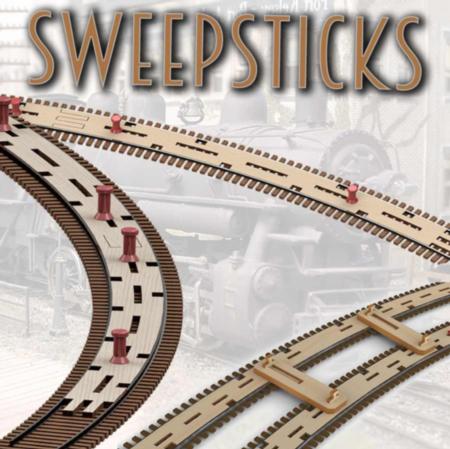
Their SweepSticks system allows you to make straight or smooth-curved hand-laid track. These aids can also be used for laying out a track plan, first. They are available for a number of different lengths or radii. See their web site for all the possibilities.
Straight Track Fixture
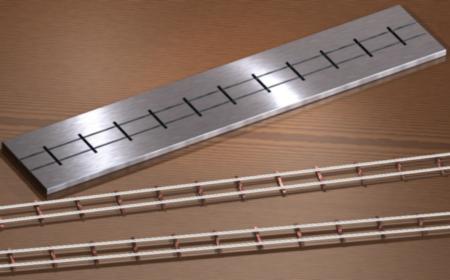
You can build your track on the workbench, effectively making your own sectional track system, using their Track Fixture system. They are available for three rail sizes, and for straight and curved tracks (various radii), and for turnouts and wyes. See their web site for what is available. The jig may appear to be expensive, but if you need to build more than a couple of uses of that track, you will find that the jigs quickly pay for themselves, if you have the ability to solder and a bit of time. Note that the curved-track fixture, for example, includes three different radii in one jig.
Trifecta
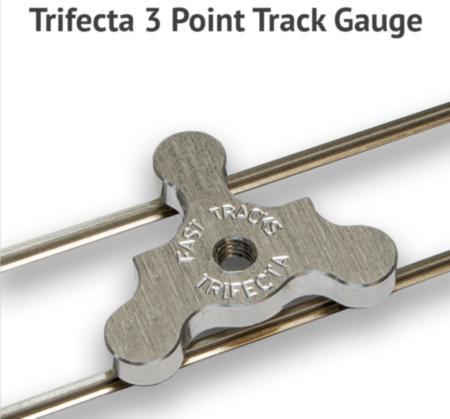
The company's Trifecta S gauge is important for making sure your track remains in gauge as you attach it to your layout, module, or diorama. They have two different ones available (see their web site), depending on which size rail you use. You will definitely need these if you hand-lay your track without using their jigs.
SpaceGauge
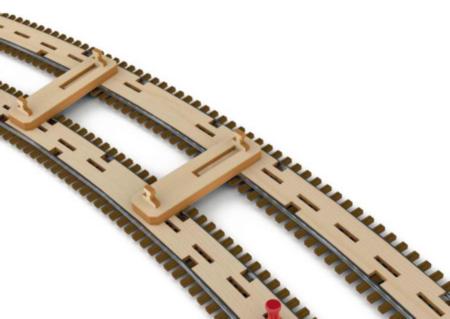
Their SpaceGauge jig (see their web site) allows you to properly space parallel tracks together. Various spacer sizes are available.
Micro Engineering
Micro Engineering manufactures rail in various code sizes, both weathered and unweathered.
Railway Engineering
Owned by an S-scale modeler, Railway Engineering produces turnouts to your specifications. They carry track gauges.
S Scale Track Works
S Scale Track Works, a company formed in 2019, produces turnout components in codes 70, 83, and 100. You can buy the full kits, or you can buy the individual parts. Other parts, and parts for other codes of rail, can be produced upon request.
Smoky Mountain Model Works
Smoky Mountain Model Works offers tie-spacing templates, rail gauges, and track detailing parts.
Trout Creek Engineering
Trout Creek Engineering offers turnouts with various frog numbers, using anywhere from code 148 to code 55 rail. They also offer crossings, and individual frog assemblies.
Turntables
Port Lines Hobby Supply provides a motorized turntable, customized to your desired diameter of between 16" and 32".
Millhouse River Studio, who specializes in high-end O-scale turntables and transfer tables, states on their web site that they can manufacture any of their turntables for S-scale as well.
In the past Bowser used to make some S-scale turntables, but they have stopped manufacturing turntables (they may still be available on the secondary market, though, hence our listing of them).
New York Railway Supply manufactures a turntable control system (independent of scale). The owner is an Sn3 modeler.
In 2017 Dallee Electronics introduced their turntable indexer.
With a little bit of creative effort, some modelers have taken turntables and transfer tables that were intended for scales other than S, and made them compatible with their S-scale layout. Most of the time it involves just changing the track and maybe the ties of the bridge.
Track Gauges
When laying track, with the exception of, perhaps, pre-fabricated track systems, you are going to need a rail gauge. The NASG sells the gauge via our online store.
Roadbed
There are a couple of commercial roadbed manufacturers that will make S-scale roadbed. You can also use a combination of HO- and O-scale cork roadbed, one side HO the other O, to get a satisfactory S-scale roadbed. Alternatives are cork, ceiling tiles, homasote, and (for pre-fabricated track systems) 3M's "Scotchfil".
F.A.Q.
What size curves can I use?
It depends upon the equipment you want to run. Locomotives vary from as little as needing a 19-inch radius up to 48-inch radius for the long-wheelbase steam locomotives. Long freight and passenger cars will also appreciate wider curves, although they will usually operate on sharper curves if the entry to the curve is "eased", i.e. gradually getting sharper instead of going instantly to maximum curvature. Lionel's engines typically (but not all) have a swinging pilot so that they can negotiate the sharper curves typically found on true A.F. layouts. For true scale modelers, some of these engines can be modified to permanently fix the pilot to the body frame, but they may require some effort by the owner.
How steep a grade can the trains take?
The model trains are much like the real thing; the steeper the grade, the shorter the train that can be pulled up the hill by a given locomotive. You can cut the train length by about half for every one percent of grade, so a two percent grade will cut a maximum length flat-land train length to about one quarter of its original size. Grades of over 1/2 inch rise per foot are not recommended. The wheels on the cars that your engine is pulling is a big factor. Using high-quality, free-rolling wheels on your freight and passenger cars will make it much easier for your engine to pull the load up the grade.
Can I run both American Flyer and "fine scale" equipment on the same track?
Yes and no. The rail has to be tall enough to handle the large flanges of the American Flyer trains, and the turnouts will have to be one of the multi-purpose versions that have been made (a.k.a. "closed frog") and they will have to be gentle enough in their diverging route curve that the scale trains won't bind up. Generally speaking, it is better to use track that matches the type of rolling stock. Another difficulty in combining AF with scale trains is the electrical requirements; AF is usually (but not always) AC, and scale is DC. Some people change their AF locos to DC or DCC and then that is not a problem.
Resources
The NASG developed a standard for track. You can read all about it on our Engineering Standards page. By having a well-known, publicly-available standard by which manufacturers can produce their products for S-scale, we ensure compatibility between brands, so that you can buy track from one manufacturer, and be assured that the locomotive that you bought from another manufacturer will run on that track with freight cars you bought from yet another manufacturer. If you are going to hand-lay your track, be sure to study those standards.
The UK's S Scale Model Railway Society has a great page comparing the various rail heights to S-scale equivalents.
Rick Blanchard has a wonderful web page that lists track spacing, rail sizes, brake piping, and other dimensional data, including for S-scale. He also has a web page listing how rail sizes related to the various scales, and another web page on how prototype track curvature relates to scale proportions. There is also an Excel data file listing how real world dimensions translate to S (without having to pull out the calculator).