
Articles - Track

This page provides a bit of information about A.C. Gilbert's American Flyer track system.
Original A.C. Gilbert Track System
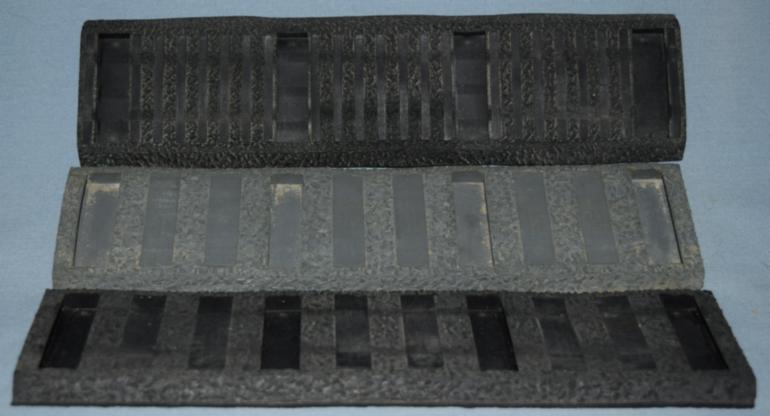
Part #726 was the rubber underpinnings for track sections that offered more quiet operation, and a simulated ballast roadbed for the original track. It also simulated the additional track ties. These were made in three variations, which are shown together in the next photo.
© Ted Hamler; used by permission
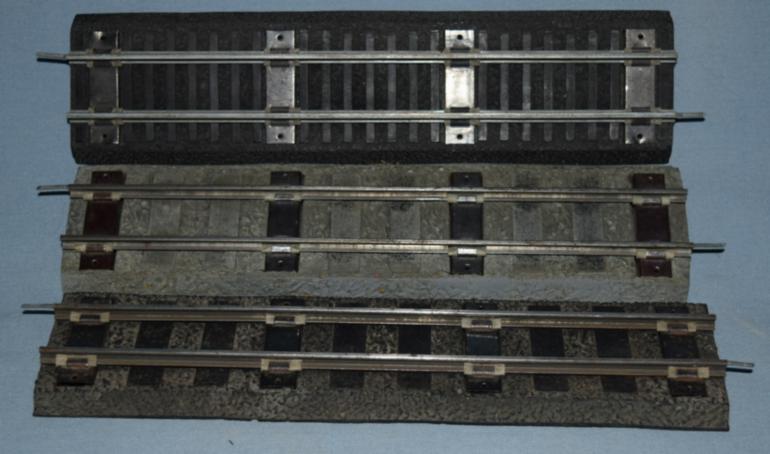
The next photo shows the track and rubber ballast together. While the track itself only had enough metal ties attached to it to make sure the two rails remained in their correct gauge, the A.C. Gilbert system of using two rails was a significant improvement toward realism over their competitor Lionel's three-rail system.
© Ted Hamler; used by permission
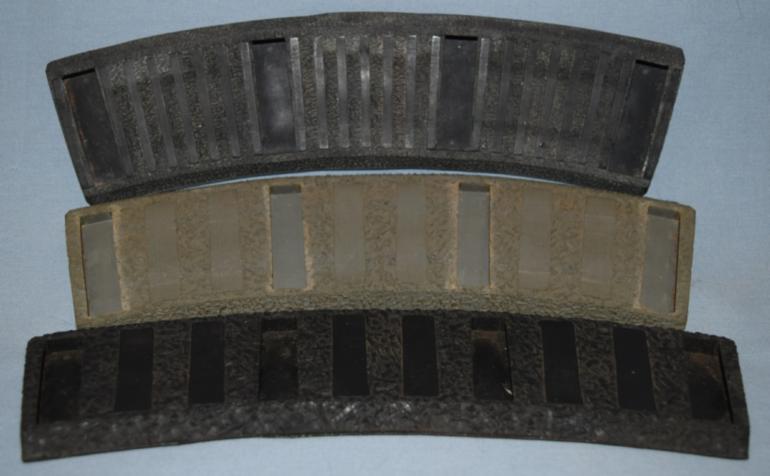
Part #727 offered the same rubber system for curved sections of track, also in three variations.
© Ted Hamler; used by permission
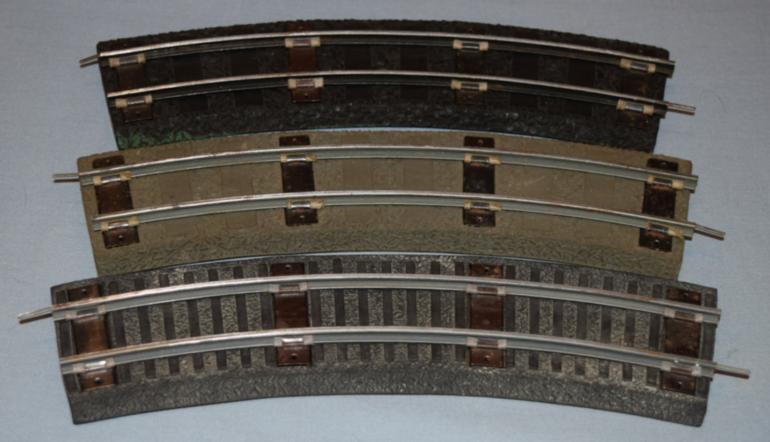
The next photo shows the track and rubber ballast together.
© Ted Hamler; used by permission
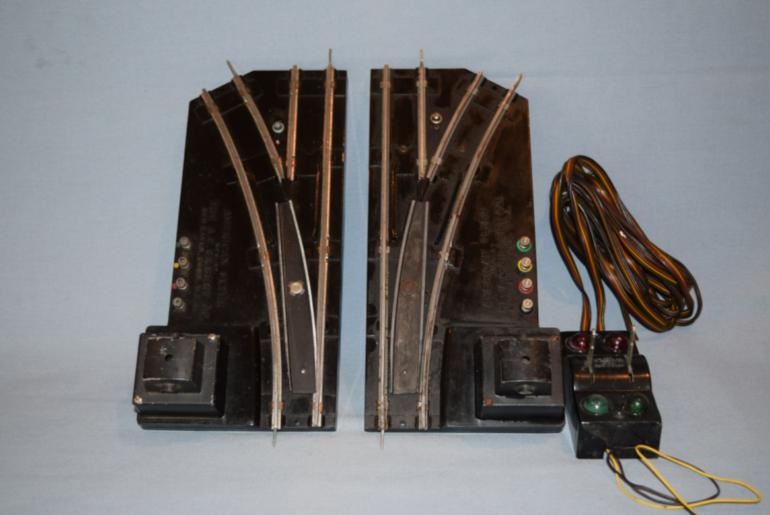
Left and right turnouts (switches) were also provided. This pair, #720A, offered remote control (manual-throw ones were also available). They use the "closed-frog" method. What this means is that the center part of the turnout, where the two diverging routes meet, the black part swivels left or right matching the direction that the turnout's points are set to. This provides a continuous track for the wheels to follow. This is not how it is done in the real world, but it did provide for bullet-proof tracking of engines and cars through the turnouts.
© Ted Hamler; used by permission
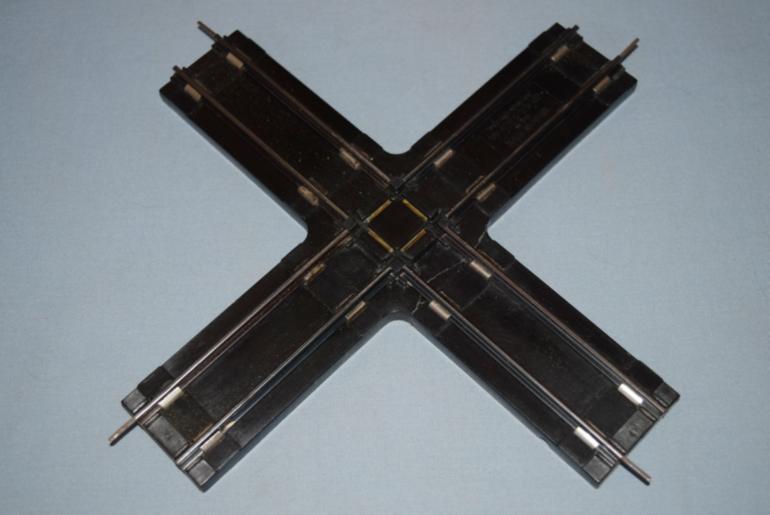
A.C. Gilbert also manufactured crossings. This one, part #725, offered a 90-degree crossing.
© Ted Hamler; used by permission
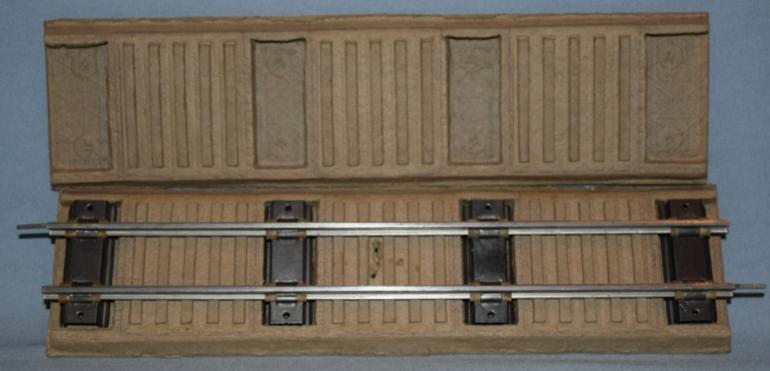
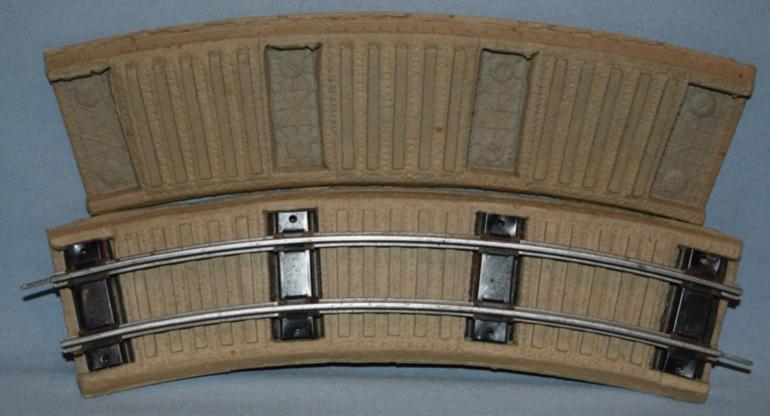
A fiber-board sub-roadbed was also produced. These photos show part #26601 and #26602 with and without track installed.
© Ted Hamler; used by permission
© Ted Hamler; used by permission
Pike-Master A.C. Gilbert Track System
Starting in 1961, A.C. Gilbert introduced their Pike-Master track components, which increased the realism of track to a whole new level. The look of it is not too dissimilar from today's sectional track systems, regardless of scale. The example shown in the photo is part #26300, which is a ten-inch straight section. It has a mounting hole in one of the ties, to allow the customer to apply a screw or nail through it, to fasten the track to a substrate.

© Ted Hamler; used by permission
Part #26301 is a short section of straight track.
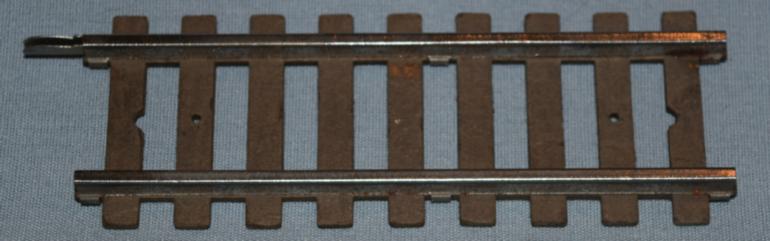
© Ted Hamler; used by permission
Curved track was also produced for this system, this example being part #26310.
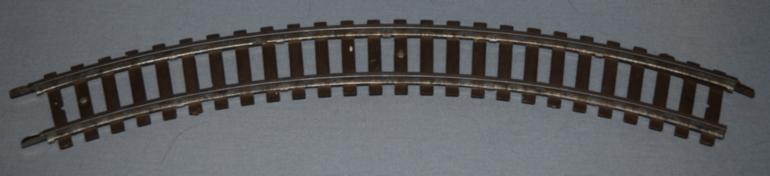
© Ted Hamler; used by permission
Turnouts were also produced. This one is part #26320, a right-hand turnout (a matching left-hand one was part #26321). These could be hand-thrown or remote controlled. Note that these did not have the closed-frog solution, but much more simulated the real world frogs. A side note: If you look at the guard rails (the short sections of rails near the frog point) you will see that they are a good ways away from their adjacent rails. It is this wider gap, which is required for the larger A.C. Gilbert wheelsets, that causes "scale" equipment to not operate correctly on these turnouts; there is too much "play" for the thinner scale wheels, and so it is easy for them to pick the frog and derail.
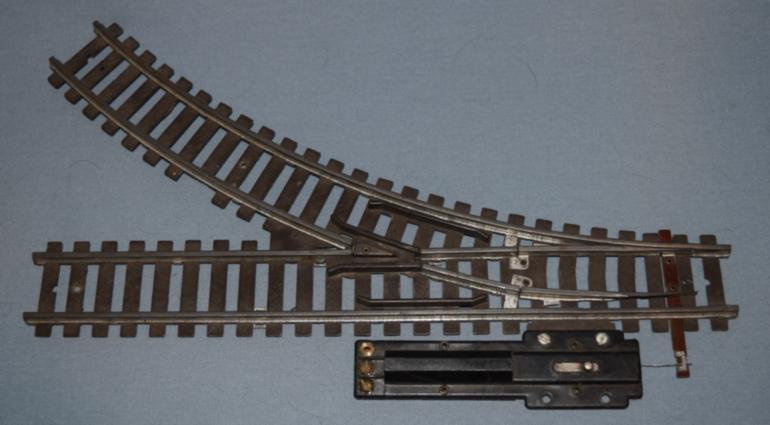
© Ted Hamler; used by permission
Here is an example of part #26322, which is the 90-degree crossing for the Pike-Master system.
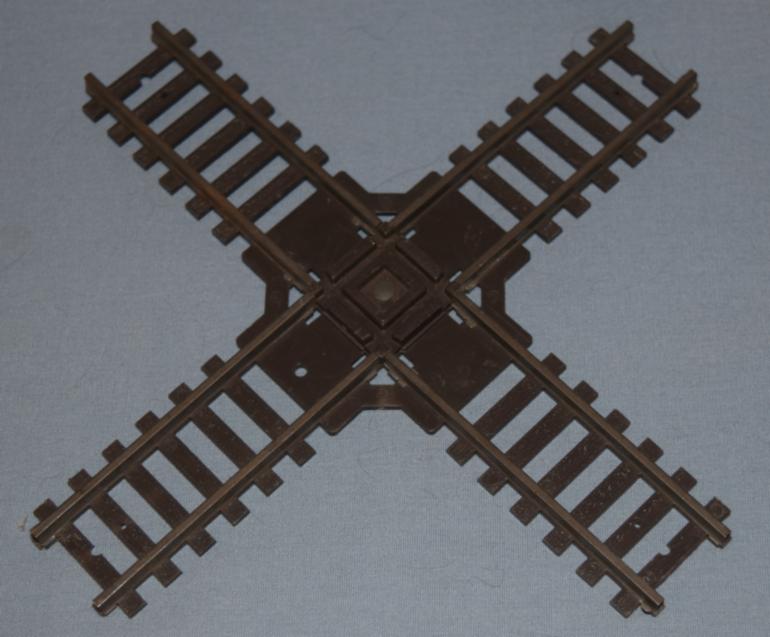
© Ted Hamler; used by permission
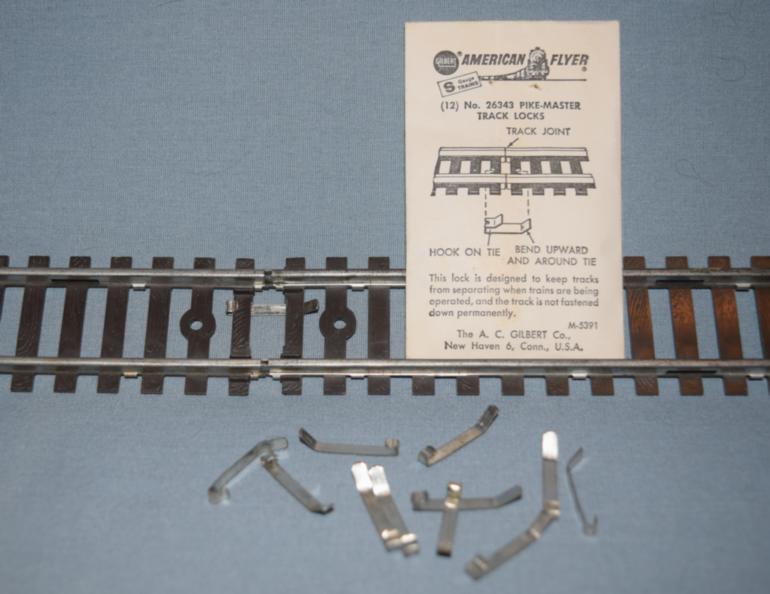
To hold the different sections of track together, A.C. Gilbert produced part #26343, which is a package of track locks that snap in under the ties.
© Ted Hamler; used by permission
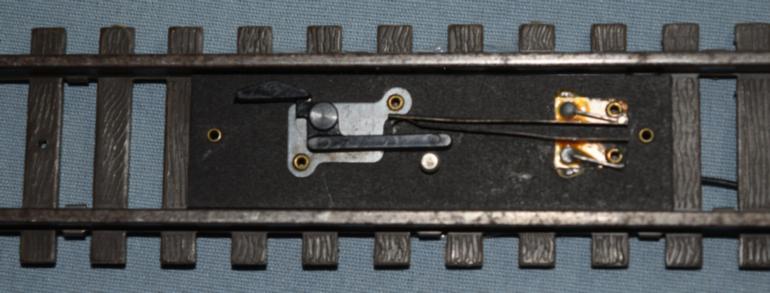
To trigger animations, these track trips could be installed. This is part #XA16A593, shown here installed in a piece of Pike-Master straight track.
© Ted Hamler; used by permission
For our complete listing of A.C. Gilbert track components, see this page.
Where To Buy These?
Since A.C. Gilbert went out of business in 1966, these original components are no longer being made. However, there are secondary sources available, such as eBay and asking others what they have for sale on the various Yahoo Groups and Groups.io lists, and discussion forums. Port Lines Hobby Supplies is one retailer who still carries used A.C. Gilbert original items. There may be others (see our track resources page).
If you are not necessarily committed to making a 100%-pure A.C. Gilbert-only layout or display, you could explore different brands that make compatible track systems today. These would be:
- GarGraves (probably the best match, and they offer flextrack)
- Lionel (code 133)
- American Models (code 148)
- American S-Gauge (code 172)
MTH and the former S-Helper Service (code 139)ScaleTrains has bought the SHS/MTH track system and have indicated that they plan to produce the track components again in the future- Fox Valley Models (code 138)
Note that the NMRA classifies, for S-scale, anything code 125 or taller as "hi-rail" or "deep-flange". The word "code" means, the rail height in one-thousandths of an inch. So, "code 125" is 0.125 inches, or 1/8", tall rail. Your rail height requirements depend on which types of wheels you have on your engines and cars. If the flanges of the wheels are taller than the rail height, the flanges will be hitting the ties, which leads to rough-running, noise, and derailments. Generally, equipment with smaller flanges will run on tall-rail track, but not the other way around. The only major issue is with regard to turnouts. A.C. Gilbert turnouts used a wider spacing on their guard rails, which means more-to-scale equipment may wander too much when used on those turnouts, and may cause them to derail. You will have to experiment with that, if you plan on mixing original A.C. Gilbert track and equipment with more modern track and/or equipment.
External Links
How to repair very worn A.C. Gilbert AF turnouts: part 1, part 2, part 3
How to Make Original Gilbert Track Look Better (for a test track).
A.C. Gilbert Turnout Articles, and track and track control.