
The S Scale SIG
The S Scale Journal
Volume 2 No. 3, March 25, 2013

Lionel USRA 2-8-8-2 Y-3 Review
By Dick Karnes
Photos by Gary Schrader except as noted
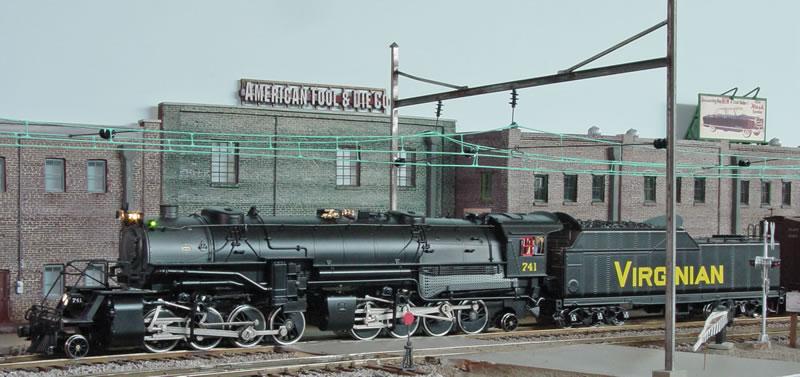
Lionel's new USRA 2-8-8-2 in VGN livery powers a freight through the North Cornwall industrial district on Dick Karnes' S scale NYW&B railway. Scale wheel and coupler conversion is a commercial offering of S Scale Locomotive & Supply Co. (Note: Pilot and trailing wheelsets on production models are solid, not spoked.) Dick Karnes photo.
An S scale Locomotive From Lionel? Yes!!
The USRA 2-8-8-2 locomotives, built by Alco and Baldwin, were delivered to the Virginian, Norfolk & Western, Baltimore & Ohio, and Clinchfield railroads in 1918 and 1919. Later, the Santa Fe, Pennsylvania, and Union Pacific bought some second-hand from the N&W. The B&O subsequently converted theirs to a 2-8-8-0 configuration. These locomotives were compound articulateds, utilizing exhaust steam from the trailing engine unit to drive the pistons in the larger cylinders on the lead unit. These locomotives, with their 57" drivers, were well suited for long coal drags at 30mph.
This new S scale USRA 2-8-8-2, as conceived by Lionel, marketed under the "American Flyer" name, and converted by SSL&S, is a real treat! Its dimensions are accurate and detailing is thorough. Piping and fittings are individually applied. It even has drive wheel brake shoes. The only obvious compromise is that the steam exhaust pipes leading forward from the rear cylinders are integral with the boiler casting, and therefore do not actually connect to the cylinder chests. The reason for this is that both the front and rear engine chassis are separately pivoted on the loco, thus minimizing outward swing of the smokebox on curved trackage, as well as allowing the loco to negotiate sharper curves. On the prototype, the rear engine does not pivot.
The loco comes from Lionel painted and lettered for VGN, N&W, PRR, ATSF, and UP. The N&W, with by far the largest fleet of these locos, designated them Class Y-3; thus the Lionel nomenclature. The locomotive comes with sound, smoke, and compatibility with AC, DC, and TMCC Legacy, and American Flyer-compatible wheel profile. The locomotive's electronics suite senses the nature of the power supply and automatically initializes itself accordingly. Lionel and S Scale Locomotive & Supply Co. (SSL&S) have entered into a mutual arrangement whereby SSL&S will replace the AF-compatible wheels and driver tires with scale-profile wheels and stainless-steel driver tires per the NASG/NMRA wheel profile and gauge standards. This conversion service also includes a Kadee S scale tender coupler. (The front coupler, a scale dummy, is standard on the Lionel product.) On request, SSL&S will also program the built-in decoder for DCC compatibility.
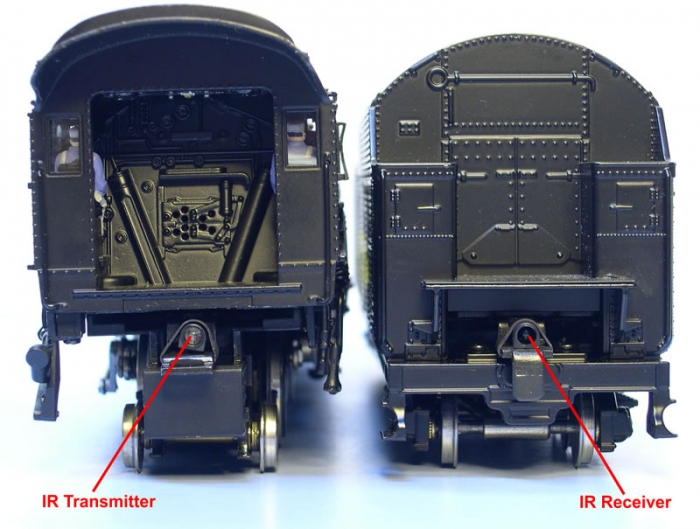
There are no wires between the Y-3 and its tender. The infrared transmitter/receiver pair that straddles the loco-tender coupling synchronizes the tender-contained sound system with the loco's driver speed and acceleration/deceleration. Propulsion electrical pick-up is all contained within the locomotive. Note the detailed and manned cab.
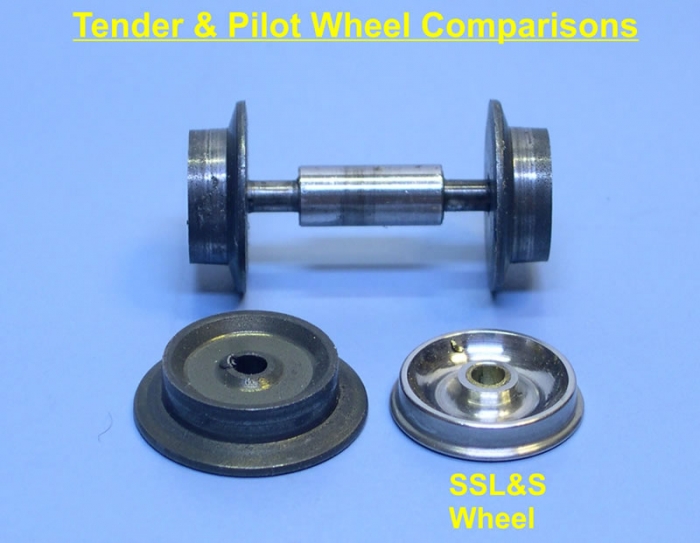
SSL&S also replaces the tender, pilot, and trailing-truck wheels. The tender's split axles are held together in an internally-insulated sleeve in order to accommodate all-wheel electrical pick-up.
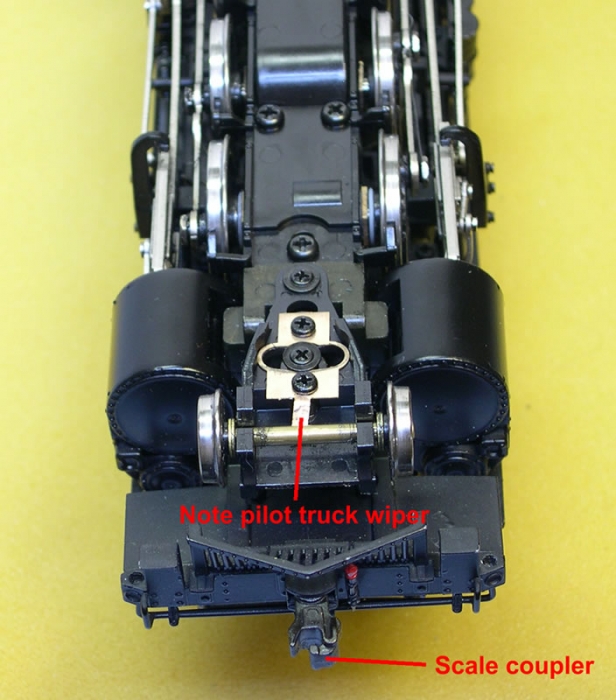
In addition to the drive-wheel electrical pick-up, the pilot (shown) and trailing truck both sport current-pick-up wipers. The loco comes from Lionel with a dummy scale coupler in front. It shouldn't be too difficult to replace it with a Kadee.
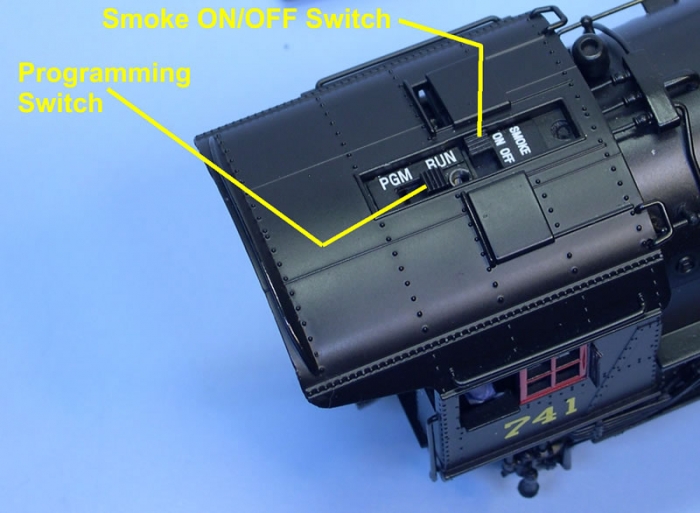
The center hatch on the cab roof pops off, revealing both the programming switch and the smoke on/off switch. Note the separately-applied grab iron and turret detail.
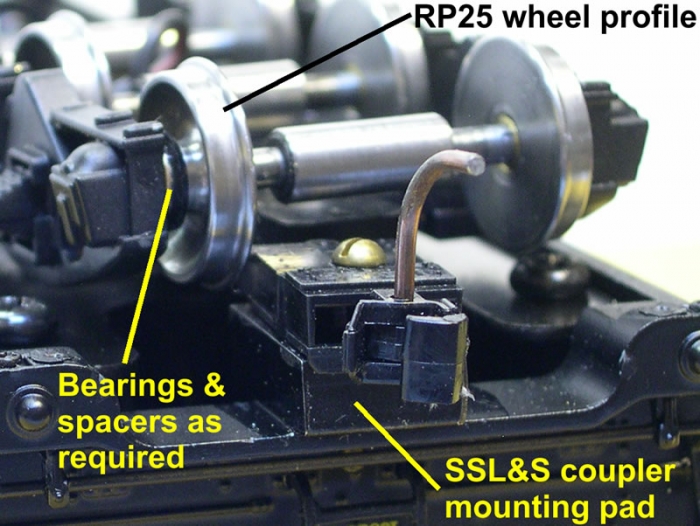
This close-up of the tender rear shows the Kadee coupler and NMRA-standard wheels as applied by S Scale Loco & Supply.
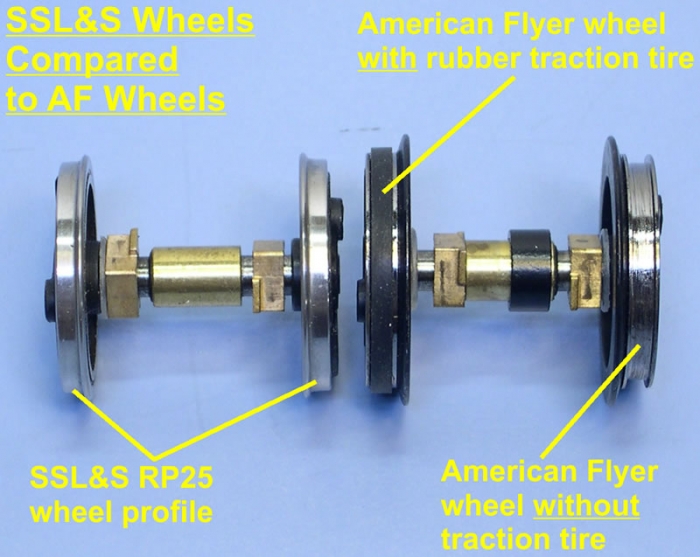
S Scale Locomotive & Supply Co. (SSL&S) removes each Lionel/AF driver tire, turns down the integral flange, force-fits a new NMRA-standard RP-25-compliant tire, and gauges the tires per NMRA standards. Shown here are the before and after configurations.
The locomotive and tender coupling is a simple hook-and-slot arrangement. There are no wires between the two units. The tender drawbar's clever design provides extremely close coupling while preventing the loco and tender bodies from interfering with each other on sharp curves. The sound system, entirely contained within the tender, is synchronized with locomotive performance via an infrared signal transmitted from beneath the cab floor and received via a receptor beneath the fireman's platform on the tender. Sound volume can be altered via a thumbwheel beneath the tender's water hatch.
In addition to the usual steam locomotive sounds, the superb sound system's effects include brake squeal, amplified chuffing upon acceleration, intermittent steam emission and crew chatter when idling. The sound system electronics are very sensitive to electrical input fluctuations, so Lionel has provided space and connections for an optional nine-volt battery inside the tender. I highly recommend installing this battery, which provides continuous current to the sound system regardless of track-to-wheel current interruptions. Another advantage of the battery is that it allows the sound system to bank the fire after the DCC system is turned off. Yes, after turn-off!
I tested the locomotive using DCC. Electrical pick-up is through the wheels on both sides of the unit. The loco weighs 3 pounds 7 ounces; the tender weighs another 2 pounds 3 ounces. Loco pulling power, without the tender, is 11.3 ounces at full slip while drawing .50 amperes. The loco's efficiency (pulling force divided by loco weight) is 20.5 percent - an incredibly high number. The stainless-steel driver tires' excellent adhesion properties allow the loco to pull practically everything you can throw at it. The loco begins to crawl at 3.4 scale mph at step 1 on the DCC 28-step speed control table. Its speed at full throttle (speed step 28) is 76 scale mph; the prototype could be wound up to 50 mph. Using DCC's configuration variables, the speed profile can be reprogrammed to approximate the prototype if one wishes.
I had a problem with drive wheel set No. 1 lifting off the rails at the beginning of downgrades. After much theorizing and tinkering, I found that the pilot truck spring is much too stiff. I removed the spring and did not replace it. To compensate, I added a quarter-ounce rectangular weight to the top of the plastic lead truck frame to keep its wheels on the track. MicroMark makes half-inch-wide peel-and-stick quarter-ounce lead weights, perfect for this application. These simple alterations eliminated the driver lift-off problem. And, although I did not retest, elimination of the spring increases pulling power by transferring more weight to the lead chassis.
The smoke unit can be turned on or off via a hidden switch beneath the cab roof hatch. Lighting effects include a reversible headlight and tender rear light, illuminated classification lights, red firebox glow, firedoor flicker, and cab interior.
Note: Scale conversion by SSL&S voids the Lionel warranty. However, SSL&S separately warrants its conversion work. List price: $995. SSL&S scale conversion price: $550. DCC implementation: $75. Shipping is not included in these prices.