
The S Scale SIG
The S Scale Journal
Volume 1 No. 6, March 3, 2012

Lionel's U33C S Scale Diesel
By Ed Loizeaux
photos by Dick Karnes
The General Electric U33C is the first totally new diesel locomotive made by Lionel for American Flyer and S scale enthusiasts. "Lionel is not the company it used to be!" was my first thought as I opened the box: a new diesel featuring scale wheels. Yes, you read that correctly. It ran for six non-stop hours on my home layout, which features code .100 rail throughout, laid to NMRA specifications. There was nary a trackability or performance problem with through dozens and dozens of turnouts - quite a change from the goode olde daze of A. C. Gilbert.
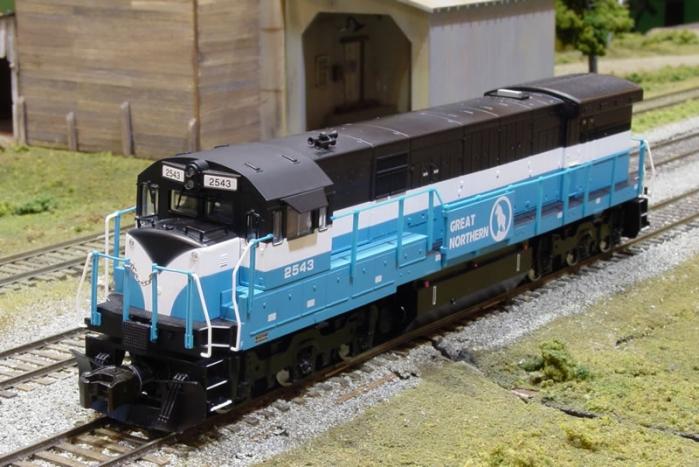
Fig. 1. Great Northern is just one of the several liveries in which the Lionel U33C is offered. This head-end shot was also taken on the BASS layout.
This product represents Lionel's toe-in-the-water venture into the S scale market. Compared to older American Flyer products, it's quite an improvement in the realism department. The very nice body molding, while not perfect, is realistic enough for most S scale modelers. The engine comes with large AF couplers on both ends that can easily be removed (one screw) and replaced with a scale coupler bracket (two screws). A Kadee #802 coupler screws to the bracket with two more screws. Lionel even includes the needed screws in a small parts bag. The purchaser can easily make a flat plastic filler piece to fill the large hole in the pilot resulting from the removal of the AF coupler. Someone at Lionel was thinking ahead on this feature.
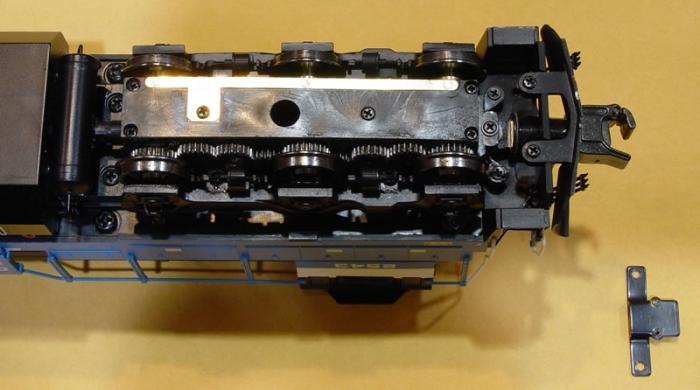
Fig. 2. This bottom view of one of the two power trucks shows the scale-contour wheels, the gear train that drives all three axles, and the AF-compatible coupler that's mounted with a single machine screw. To replace the coupler with a Kadee 802/803/808, simply remove the screw, then use the two other machine screws, already in place, to attach the Kadee adaptor bracket (lower right). Kadees mate directly with the adaptor bracket.
All twelve metal wheels are powered and all wheels pick up electrical power from the track. Rubber traction treads are in the box, but not intended for use with the scale wheels. Headlights and back-up lights are LEDs that automatically reverse with direction changes. Sound and smoke are also included, as well as a motorized fan to blow the exhaust smoke upwards continuously. The horn sounds were particularly appealing to my visitors who watched the U33C circle the layout.
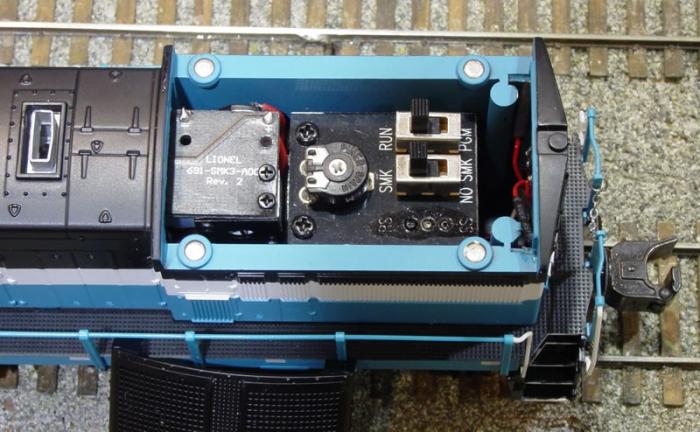
Fig. 3. The radiator grid, held in place by four tiny magnets, pops off to reveal two electric switches and a smoke-fluid filler cap. One of the switches turns the smoke on and off; the other switches the locomotive between "programming" and "run" modes.
Lionel's Legacy proprietary command control system (similar to DCC, but not the same and not mutually compatible) comes installed in the locomotive. For this product to operate with all features functioning, a Lionel Legacy command control system and Legacy throttle/cab must be used. Otherwise, the loco will operate on conventional AC, but some of the special features cannot be activated. As it comes from the factory, the loco will not operate on DC or DCC.
If desired, the internal Legacy electronics can be removed. Once removed, the conventional DC motor that resides in the fuel tank may be powered with ordinary DC or a DCC decoder if desired. Some scale modelers have already sold off Legacy electronics to their AF buddies, which helps pay for a new DCC decoder. My prediction is that Legacy electronics will soon appear on eBay. As my evaluation was done with Legacy, I cannot predict how the loco will perform with conventional DC or DCC.
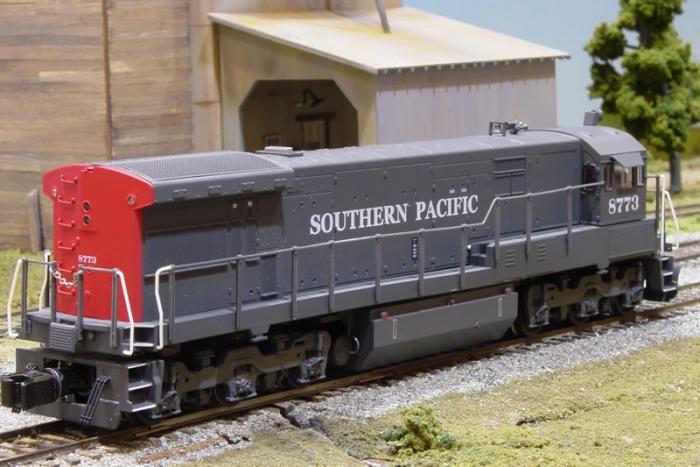
Fig. 4. Replacing the AF-compatible couplers is all that's required for Lionel's new U33C to compete with the appearance and detailing of the best of S scale products. Here we see a rear view of the Southern Pacific version parked next to a grain elevator on the Bay Area S Scalers' (BASS) layout at last February's O/S West.
This is only a "quick look," not a review. I did not compare every detail to the prototype, instead concentrating on the features easily noticed without a magnifier. In no particular order, my observations are listed below:
- Metal grab irons are separately applied details.
- Handrail stanchions and handrails are a flexible one-piece molded Delrin part that's quite resistant to breaking from excessive bending.
- Lettering is precise and apparently complete, including features such as the GE builder's plate and stencils such as "Air Filter," "Danger High Voltage," and "Diesel Fuel Fill."
- The body is injection-molded plastic with lots of detail.
- Frame/floor/chassis is a heavy hunk of metal which is very rigid and firm, great for tractive power.
- Trucks are metal, rigid, with cast springs and nice detailing. The fuel tank is cast metal and heavy.
- There are twelve air hoses on the pilots.
- The MU walk-through platform can be positioned "up" or "down"; there's a detent to hold it in place.
- Headlights (white), backup lights (red), number boards (white), and cab lights (white) are all illuminated. However, the infamous bluish tinge is present in the white LEDs.
- The body molding has molded-in machined brass threaded inserts which are used when attaching the frame to the body. Thus, there is no chance of stripping out the screw threads.
- The flared radiator on the top of the body can be removed to expose two small electrical switches. One turns the smoke generator and fan on and off. The other is to set the loco up for programming or for running. The radiator is held in place by four tiny super magnets. Cool!
- Both pilots swivel with the trucks around curves. This design looks rather toy-like, but it appears they could be firmly attached to the frame without too much difficulty. My first thought is to use a piece of 1/16" thick black plastic and cut it to the proper shape and then epoxy it to the underside of the frame. Then attach the pilot parts to the plastic piece with epoxy or JB Weld (if sufficiently strong) or with small screws (drilling and tapping required). Eventually someone will actually do this and we'll have a better idea of the difficulties involved, but it doesn't look particularly difficult for an experienced modeler.
- Due to the swiveling pilot, the end handrails do not extend downward far enough to match the prototype. The handrails could be extended, if desired, once the pilot is firmly attached to the frame.
In closing, it appears that Lionel is seriously testing the S scale market segment with this product. While not perfect, it's a remarkable step forward toward greater realism, worthy of a serious look. Is it possible that Lionel/AF is the sleeping giant of S scale? What a thought!