
Standard-gauge Wheels

Wheels are wheels, right? Well, not quite. For S-scale modelers there are a few options. While most modelers will develop a standard for their wheelsets used, it is entirely possible to run your equipment with different wheelsets under different cars and engines. The wheelsets that are options for you are dictated by how your track work is done. We will not discuss the oversized wheels used on A.C. Gilbert-based equipment; although it is, of course, possible to replace the trucks and wheelsets on those kinds of cars to have them run on "scale" layouts.
"Code"
The overall width of a wheel is denoted by the letter "N" in the NASG/NMRA standards (see Engineering Standards page). It is called a wheel's "code", which is the width of the wheel in one-thousandths of an inch. The most common wheel that S-scale modelers use is known as "code 110" wheels. If you ask a manufacturer or retailer for "scale" wheels, these are the kinds of wheels that you typically get. For those who want to have an even more-to-scale look to their wheelsets, S-scale also has code 88 and code 87, the latter commonly referred to a Proto:64. The photo below shows an overhead view of several available wheelsets. One important thing to note is that, as the wheel's width decreases, so does its flange depth. So, while you might quickly decide that code 87 is the way to go, its flange depth is quite small, and so your track work and your equipment's tracking abilities have to be top-notch to be able to have reliable operations. That's way most S "scale" modelers tend to use code 110 wheelsets; it is a compromise between scale fidelity and operational reliability. Code 110 wheels will work on any regular "scale" track. Code 88 wheels will work on well-laid track (mostly the turnouts are of concern here). Code 87 is primarily used for Proto:64 layouts, which require very close adherence to NASG/NMRA track standards. The reason for there being two code 88 wheels in the photo below, is that their wheel treads are slightly different; the one on the left is slightly wider. From left to right, the manufacturer of the wheels are: S-Helper Service, Northwest Shortline, S Scale Locomotive & Supply (Fred Rouse), Northwest Shortline.

copyright © Peter Vanvliet; used by permission
For comparison, the following are the wider wheels found in S-scale. For reference, the left-most one in the next photo is the same as the left-most one in the above photo. Note that the wheelsets marked as manufactured by S-Helper Service are going to be identical to those produced by MTH, and are likely to be identical to the ones that ScaleTrains is now producing, as they are all based on the same designs that S-Helper Service originated.

copyright © Brooks Stover; used by permission.
Flanges
A flange (or the ridge along the inside edge of the real railroad's wheels) is not what keeps a prototype railroad's equipment on the track. The wheel thread is slightly angled with respect to the rail so that the weight of the equipment will want to push the wheel toward the center of the track. The wheel on the other side of the axle will attempt to do the same thing, and thus the whole truck stays in the center of the rail spacing.
This works in the real world due to the sheer weight of all the equipment riding on the wheels. We do not have that same benefit in our scale models. So, in the model world, we do need to rely on the flanges to keep the wheels on the track. The faster you run your equipment, and/or the sharper your curves are, the taller your flanges need to be.
For code 87 wheels, the flanges are about as close to the prototype wheels as we can get in S-scale. Because the flanges are shallower on those, if your track work is not near perfect, you will likely see derailments routinely. Code 88 wheels offer a slightly taller flange, but they still offer a close-to-prototype wheel thread dimension, to make the models look authentic, but not derail as easily. If you are not too concerned about the visual width of code 110 wheels, then they provide the most reliable wheels for track. Please note that the S-scale standard for code 110 wheels state that the flange depth ("D") must be 0.030", which means code 55 rail and taller should be perfectly usable with code 110 wheels (spike heads may be a concern). In other words, you should not need to limit yourself to code 88 or 87 wheels sets if you wish to model light rail in S-scale. The prototype photo below shows just how shallow a prototype flange really is.
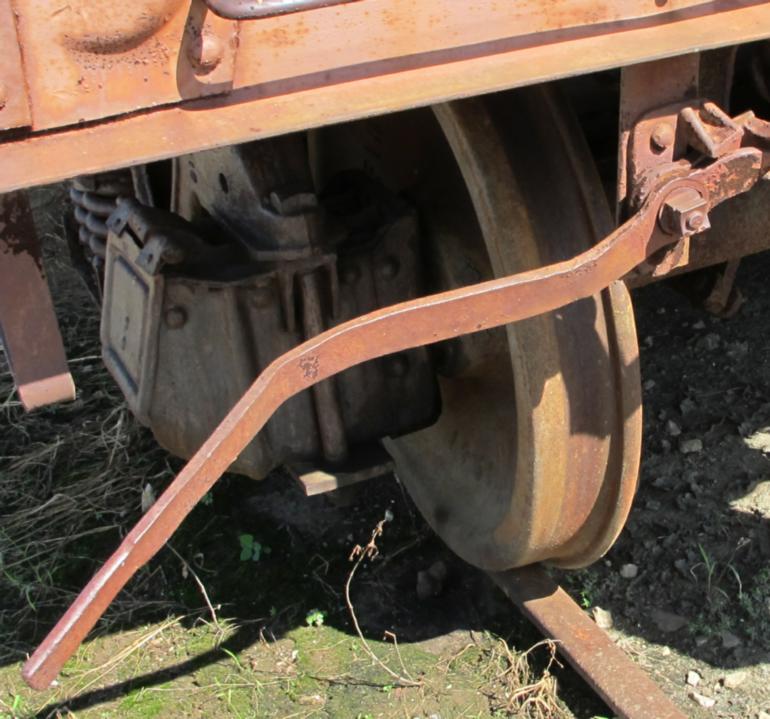
copyright © Peter Vanvliet; used by permission
Axle Ends
There is one more decision that you have to make, but this one is closely related to which trucks you are going to use under your equipment. This is, what kind of ends to your axles you should have. You can have angled/pointy ends or square/flat/blunt ends. Which one you choose depends on the amount of rolling resistance that you wish to be concerned about. Most modelers just use whatever the manufacturer used, but if you have a strong preference for one over the other, you may need to replace the trucks to accommodate the desired axle ends, or modify the journals of the trucks yourself.
Woody Mitchell set about and measured the axle lengths of various common S-scale wheelsets:
Pointed/Angled Axles
MTH:
1.2740" - 1.2750"
S-Helper Service:
1.2665" - 1.2675"
American Models:
1.2745" - 1.2775"
Pacific Rail Shops:
1.2650" - 1.2680"
NorthWest ShortLine:
1.2800"
Blunt/Flat Axles
ACE:
1.3055" - 1.3070"
Re-gauging Wheels
Dick Karnes mentions that the modeler can spread the wheels slightly on the axle by twisting the wheels against in opposite directions and slightly pulling or pushing on them, checking for the gauge often. He recommends to make sure that they are not loose on the axle after widening. If so, a spot of super-glue in the gap will cure this.
He notes, however, that for a lot of the old wheelsets, the wheel thickness is 0.125" (we currently use code 110 wheels, but some companies use or used code 125 wheels). So, after widening they will no longer fit back into the trucks from which they came. So you are faced with having to file the inside of the sideframes in the vicinity of the axle hole. He states that that is preferable to reducing the wheel thickness. Midgage Models' wheelsets are an example of being gauged to the old NMRA standard (their wheels actually scale out to 30" wheels, not 33").
Bud Rindfleisch built this handy simple jig to help him with adjusting many wheels. A light tap on the axle end with a small hammer, then checking the gauge, then repeat.
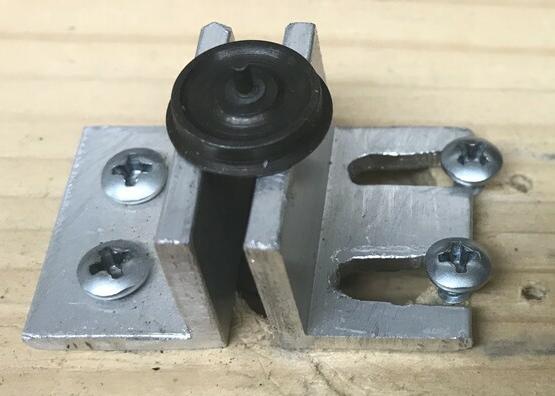
copyright © Bud Rindfleisch; used by permission