
4-6-2 Steam Locomotives for Pennsylvania Railroad (PRR)

Model Manufacturer Info
Manufacturer:
A.C. Gilbert
Manufacturer ID:
310
Additional IDs:
313, 315, 316
Prototype Info
Category:
4-6-2
Road Name:
Pennsylvania Railroad (PRR)
Model Info
Gauge:
AF
Introduced:
1946
Road Number:
310, 313, 315, 316, 317
Product Type:
Die-cast
Finish:
painted & lettered
Power:
AC
Couplers:
AF
Online Article:
Online Article:
Online Article:
Online Article:
Online Article:
Online Article:
Online Article:
Supplemental Part:
Notes:
The model was produced in 1946 and 1947, and possibly 1948. It has a diecast boiler and tender. The only operating feature was its functional headlight. There are three variations of #310. The 1946 model, shown in the photo, has "Pennsylvania" printed on the tender in silver and has thin-shank link couplers. The 1947 model has "American Flyer Lines" printed in silver on the tender with the PRR logo and has thick-shank link couplers. A third model thought to have been produced in 1948 has smoke and choo-choo and looks a lot like the 1947 model except it has a brass coupler weight. See second photo for the coupler comparisons. All of the #31x-series of locomotives have the distinctive PRR Belpaire firebox (squarish section in front of the cab).
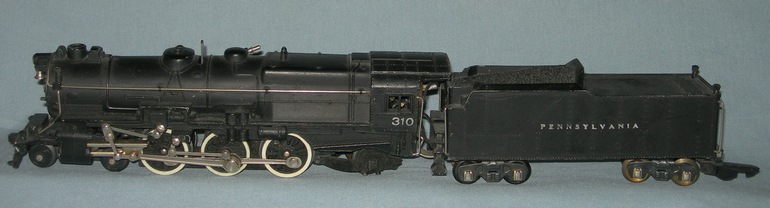
(image copyright © Ted Hamler; used by permission)

(image copyright © Ted Hamler; used by permission)
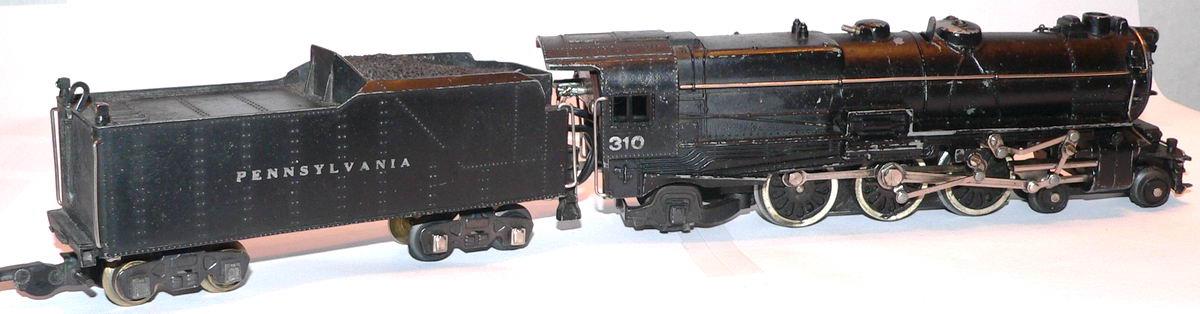
(image copyright © Jim Hammond; used by permission)
Running on Chris Monje's layout (starts at about 1:40 mark)
Model Manufacturer Info
Manufacturer:
A.C. Gilbert
Manufacturer ID:
312
Prototype Info
Category:
4-6-2
Road Name:
Pennsylvania Railroad (PRR)
Class:
K5
Model Info
Gauge:
AF
Introduced:
1946
Road Number:
312
Product Type:
Die-cast
Finish:
painted & lettered
Power:
AC
Couplers:
AF
Online Article:
Online Article:
Supplemental Part:
Notes:
This model was produced from 1946 through 1948 and again in 1951 and 1952. It features a diecast boiler and tender. The 1946 and 1947 models have lettering on the tender in silver and are the same as they were for #310. Those models also had the smoke and choo-choo sound unit located in the tender driven by a separate motor that allowed the unit to smoke and make the choo-choo sound while sitting in the parked position. In 1948 the lettering on the tender read "American Flyer Lines" and it was in white. That model had the smoke and choo-choo sound unit moved to the boiler. By doing so, Gilbert was able to utilize the drive motor to run the smoke and choo-choo unit. Because the smoke and choo-choo unit was now in the boiler, the reverse unit was moved to the tender and as such, the smoke and choo-choo unit could not work unless the engine was moving. There are five-reported variations of #312.

(image copyright © Bill Lane; used by permission)
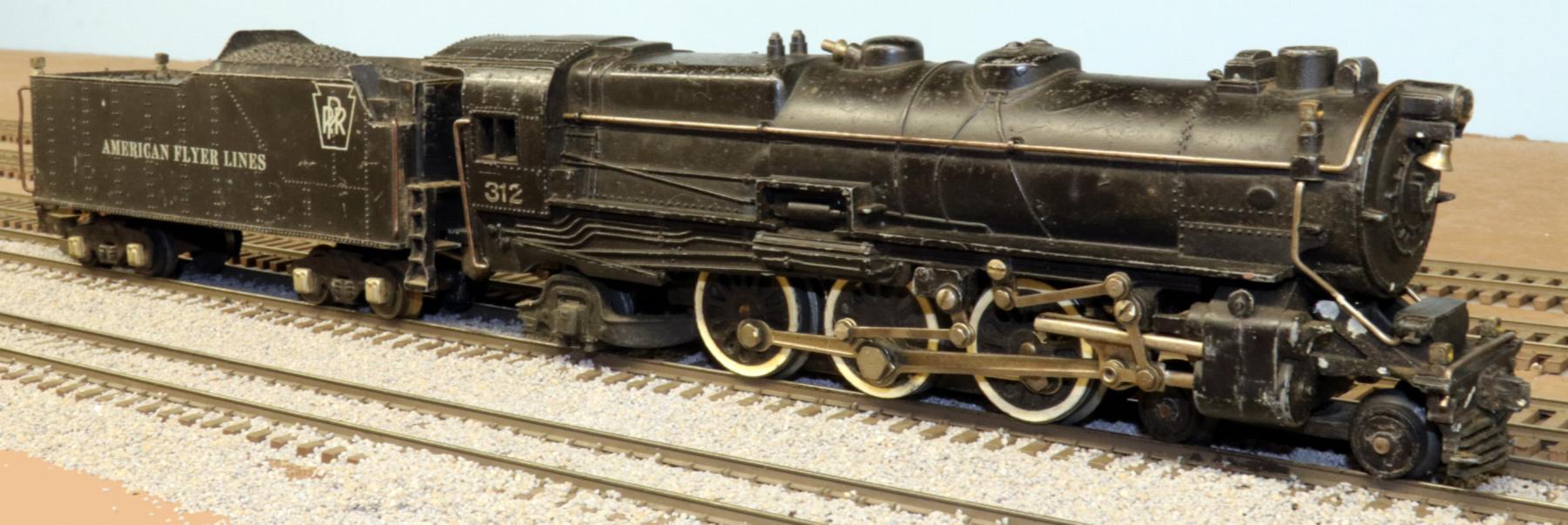
(image copyright © Bill Lane; used by permission)
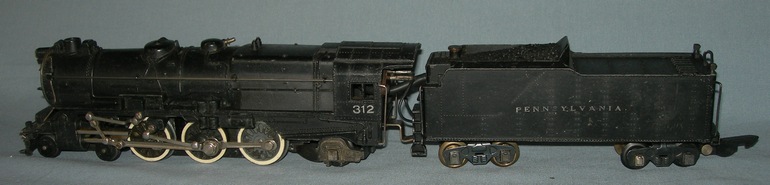
(image copyright © Ted Hamler; used by permission)
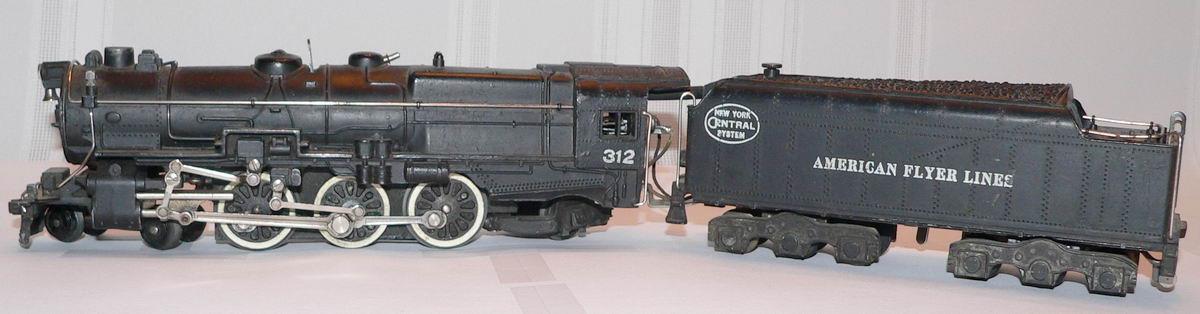
(image copyright © Jim Hammond; used by permission)
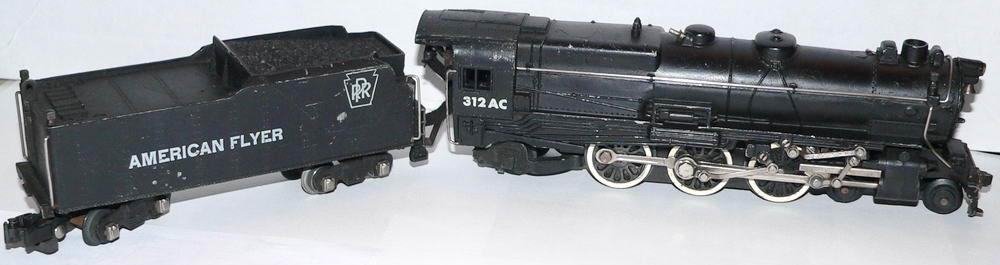
(image copyright © Jim Hammond; used by permission)
The engine running on Fred van der Lubbe's unique outdoor railroad.
Running on Chris Monje's layout, converted to scale. Starts at about the 1:20 mark.
Model Manufacturer Info
Manufacturer:
American Models
Manufacturer ID:
46201
Prototype Info
Category:
4-6-2
Year/Era:
1936
Road Name:
Pennsylvania Railroad (PRR)
Class:
K4
Model Info
Gauge:
S
Introduced:
2000
Road Number:
3768
Product Type:
Die-cast
Finish:
painted & lettered
Power:
DC, AC-with-rectifier-board
Wheels:
scale or hi-rail
Product Notes:
Notes:
Streamlined K4. This is bronze version which was painted for the 1936 World's Fair. The prototype engine was later repainted to PRR's standard Brunswick Green.

(image copyright © American Models)
Fred van der Lubbe running this engine on his outdoor layout (starts at 1:34 mark)
Model Manufacturer Info
Manufacturer:
American Models
Manufacturer ID:
46202
Prototype Info
Category:
4-6-2
Year/Era:
1936
Road Name:
Pennsylvania Railroad (PRR)
Class:
K4
Model Info
Gauge:
S
Introduced:
2000
Road Number:
3768
Product Type:
Die-cast
Finish:
painted & lettered
Power:
DC, AC-with-rectifier-board
Wheels:
scale or hi-rail
Product Notes:
Online Article:
Notes:
Streamlined K4 (Brunswick Green).

(image copyright © Bill Lane; used by permission)

(image copyright © Rich Gajnak; used by permission)

(image copyright © Bill Lane; used by permission)

(image copyright © Bill Lane; used by permission)
Running the engine, which has been converted to DCC.
Fred van der Lubbe running his engine on his garden layout.
Running on Chris Monje's layout.
The engine pulling a Halloween train.
Model Manufacturer Info
Manufacturer:
American Models
Manufacturer ID:
46006PRR
Prototype Info
Category:
4-6-2
Road Name:
Pennsylvania Railroad (PRR)
Class:
K4
Model Info
Gauge:
S
Introduced:
1995
Road Number:
5704
Product Type:
Die-cast
Finish:
painted & lettered
Power:
DC, AC-with-rectifier-board
Wheels:
scale or hi-rail
Product Notes:
Online Article:

(image copyright © American Models)
Model Manufacturer Info
Manufacturer:
Midgage Models
Manufacturer ID:
1-100
Prototype Info
Category:
4-6-2
Road Name:
Pennsylvania Railroad (PRR)
Class:
K5
Model Info
Gauge:
S
Introduced:
1947
Product Type:
Metal Kit
Finish:
unpainted
Power:
DC
Online Article:
Notes:
This kit contained the A.C. Gilbert 4-6-2 superstructure, and a custom cast-brass chassis. The kit could be built into a complete, running model, including the cast-brass PRR tender trucks. It had a Pittman DC-91 motor.

(image copyright © Jim Syphax; used by permission)

(image copyright © Jim Syphax; used by permission)

(image copyright © Midgage Models)

(image copyright © Mike Swederska; used by permission)

(image copyright © Mike Swederska; used by permission)

(image copyright © Midgage Models)
The engine being test run
Model Manufacturer Info
Manufacturer:
Omnicon Scale Models
Manufacturer ID:
1004, 1004P (painted)
Factory:
Samhongsa, Korea
Prototype Info
Category:
4-6-2
Road Name:
Pennsylvania Railroad (PRR)
Class:
K4
Model Info
Gauge:
S
Introduced:
1986
Qty Made:
125
Product Type:
Brass
Finish:
painted | unpainted
Power:
DC
Wheels:
scale
Couplers:
scale
Product Notes:
Online Article:

(image copyright © Bill Lane; used by permission)

(image copyright © Bill Winans; used by permission)

(image copyright © Gaylord Gill; used by permission)

(image copyright © Bill Lane; used by permission)

(image copyright © Omnicon Scale Models)
The engine painted and using a SoundTraxx Tsunami 2200 DCC decoder, is being test run on Mike Swederska's layout.
Model Manufacturer Info
Manufacturer:
S Scale Locomotive & Supply
Prototype Info
Category:
4-6-2
Road Name:
Pennsylvania Railroad (PRR)
Class:
K5
Model Info
Gauge:
S
Product Type:
Craftsman Kit
Finish:
unpainted
Wheels:
scale
Notes:
Built by Bob Frascella.

(image copyright © Bill Lane; used by permission)

(image copyright © Bill Lane; used by permission)
Model Manufacturer Info
Manufacturer:
Z & N Scale Tracks, Odds and Ends
Prototype Info
Category:
4-6-2
Year/Era:
1914
Dimensions:
82'
Road Name:
Pennsylvania Railroad (PRR)
Class:
K4
Ext. Reference:
Ext. Reference:
Model Info
Gauge:
S
Product Type:
3D-printed Plastic
Finish:
unpainted
Power:
no chassis
Notes:
This is a super-structure only without the smoke box front. The purpose is for the modeler to supply the additional details and to place this on top of a modeler-supplied chassis. It is not designed for any specific chassis.

(image copyright © Z & N Scale Tracks, Odds and Ends)