
Rolling Stock Trucks

This page contains links to reports covering all known standard-gauge S-scale car trucks produced over the decades. We are always looking for better photos, and any corrections or updates to the texts. Below the reports, you will also find additional information about prototype trucks.
Prototype
Limited to models that were intended for use with a particular prototype railroad.
Organized by prototype model car type (e.g. "caboose").
Model
All entries sorted by model manufacturer, then by model type.
Limited to entries that have photos, so that you can identify which truck you have.
Miscellaneous
All entries by manufacturer and model type on one page, with links to detail pages.
All entries by manufacturer and model type on one page; no photos; no supplemental information.
Limited to entries for which we do not yet have a model photo, on one page, with links to detail pages.
Limited to entries for which we do not know the model's manufacturer, hoping someone will positively identify them.
All entries with no filters applies. Use column separator of: ^ (see the "6" key of your keyboard). Most spreadsheet applications will let you pick the separator/delimiter; if not, open the file with a text editor and replace all "^" with a character of your choice.
Truck Types
There are two types of trucks used in the real world, solid bearing (from the beginning until banned from interchange in 1995) and roller bearing (from the 1930s to today).
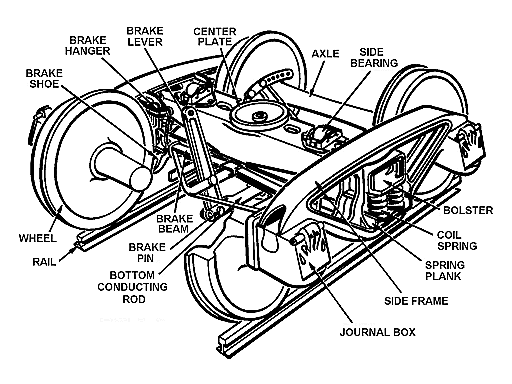 solid bearing truck; Wikipedia, public domain
Solid Bearing
The term "friction bearing" was used in marketing materials from companies that sold the newer solid bearing trucks, but it is not a valid term to use for solid bearing trucks. The term "plain bearing" is a valid one, though.
A solid bearing is an axle that rolls around in a cylinder of a slightly larger diameter, with the gap in between taken up by oil-soaked rags or cotton. The rectangular cover on the journal box could be opened to inspect and lubricate the bearing. When the bearing ran low on oil, it could overheat, leading to a "hot box". Hot box detectors were installed to visually or automatically detect any problems. A failed detection of a hot box could lead to a derailment or fire.
Solid bearing trucks were used with almost all freight cars into the 1960s. By the late-1960s they were slowly replaced with roller bearing trucks, until they were completely banned in 1995. You will still find them on captive equipment in museums or small railroads.
Popular solid bearing trucks are the Archbar, the Andrews, and the Bettendorf trucks.
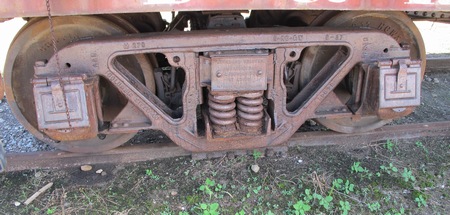 Solid bearing truck; © Peter
Vanvliet; used by permission
Solid bearing truck; © Peter
Vanvliet; used by permissionRoller Bearing
Due to their higher cost, roller bearing trucks were only found under passenger cars, until the late-1960s when freight cars started using them as well. Roller bearings consist of an outer cylinder, within which smaller rollers roll around the axle shaft. This is a sealed system, requiring no regular maintenance.
Popular roller bearing trucks are the ASF Ride Control, the Barber S-2, the ASF Ridemaster, and the National C-1.
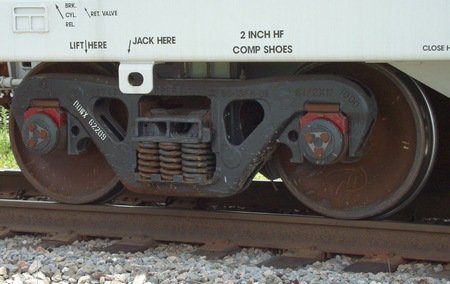 Roller bearing truck; © Peter
Vanvliet; used by permission
Roller bearing truck; © Peter
Vanvliet; used by permissionPopular Trucks
Apparently, once a truck design meets the AAR specifications, the design will be licensed to any number of foundries for the production of the trucks. That is why some trucks are identified by their designer's name, but you will find the foundry's name embossed on the truck's sideframes.
Arch Bar
Arch Bar trucks were found in the early 1900s up through December 1939, when they were banned from interchange.
Andrews
Andrews trucks were manufactured starting in 1910 and lasted into the 1930s.
Bettendorf
Bettendorf T-section trucks were manufactured in the 1910s.
Dalman
From the 1920s into the 1930s the Dalman trucks were found providing a smoother ride with their 8 springs (the bi-level ones could be found under 40' and 50' box cars that transported automobiles).
AAR Type Y
The most popular truck in the transition era was the AAR Type Y truck. This was manufactured under license from Bettendorf, and is often incorrectly called the "Bettendorf" truck (think "Kleenex" for tissues). These are also identified as the Pennsylvania Railroad's 2D-F8 truck.
Barber S-2
Introduced during World War II.
Barber S-2 50-ton: two springs, 33" wheels
Barber S-2 70-ton: three springs, 33" wheels
Barber S-2 100-ton: three springs, 36" wheels
American Steel Foundries ASF A-3 Ride Control
The solid bearing version was introduced during World War II.
National B-1
Introduced during World War II.
Allied Full Cushion
Introduced after the WWII, and up to 1955, these were used for high-speed service. However, they were banned in 1955 due to frequent derailments.
Caboose
Cabooses nearly always used leaf springs for softer rides (Barber-Bettendorf Swing Motion).
Detailing Parts
A question that comes up from time to time on the various discussion lists is, where can one purchase springs for trucks in S-scale. Jim Kindraka mentions that Precision Scale Co used to make some (since they were taken over by a different company, be sure to check with them first). Mullet River used to make some O-scale springs that were usable in S (Mullet River's product line is now owned by Des Plaines Hobbies). Another source is Century Spring (you will have to spend some time on their site to find the size that will fits your needs). "Closed and ground" are probably the ones that you want, which makes them stand up vertically on a flat surface. By the way, notice those tiny hex bolts on the trucks (see photo below)? Those are ones Jim bought from Model Motorcars. Replacement springs for the S-Helper Service trucks are the NorthWest ShortLine (NWSL) part #1412-4, which are medium-strength springs. They also have light springs, which is part #1411-4.
 example use of Century Springs springs;
photo © Jim Kindraka; used by permission
example use of Century Springs springs;
photo © Jim Kindraka; used by permissionResearch
References
- Detailing Freight Cars (Kalmbach book), chapter 2.
- 3/16 "S"cale Railroading series (Dec 1990 - Jun 1991).
- Model Railroader December 2003, pg 72 (freight). Re-published in the Detailing Freight Cars book listed above.
- Model Railroader February 2005, pg 66 (passenger).
- Railroad Model Craftsman September 2007, pg 86 (freight).
- Model Railroad Hobbyist May 2013, pg 69.
- Model Railroad Hobbyist June 2018, pg 93 (freight).
- RailModel Journal February 1990, pg 28 (freight - part 1).
- RailModel Journal April 1990, pg 60 (freight - part 2).