
Stanton Drive Product Notes

NorthWest ShortLine's Stanton Drive is now available for S-scale modelers as well. You have the option for a powered truck or a non-powered truck. If you want to save some money and you don't need the pulling power of two trucks, you could get one powered and one non-powered truck for a typical diesel locomotive. For those not familiar with these drives, they hold both the motor and their gearing inside the "box" that make up the truck, thereby opening up the entire interior of the model. These drives are compatible with DCC decoders.
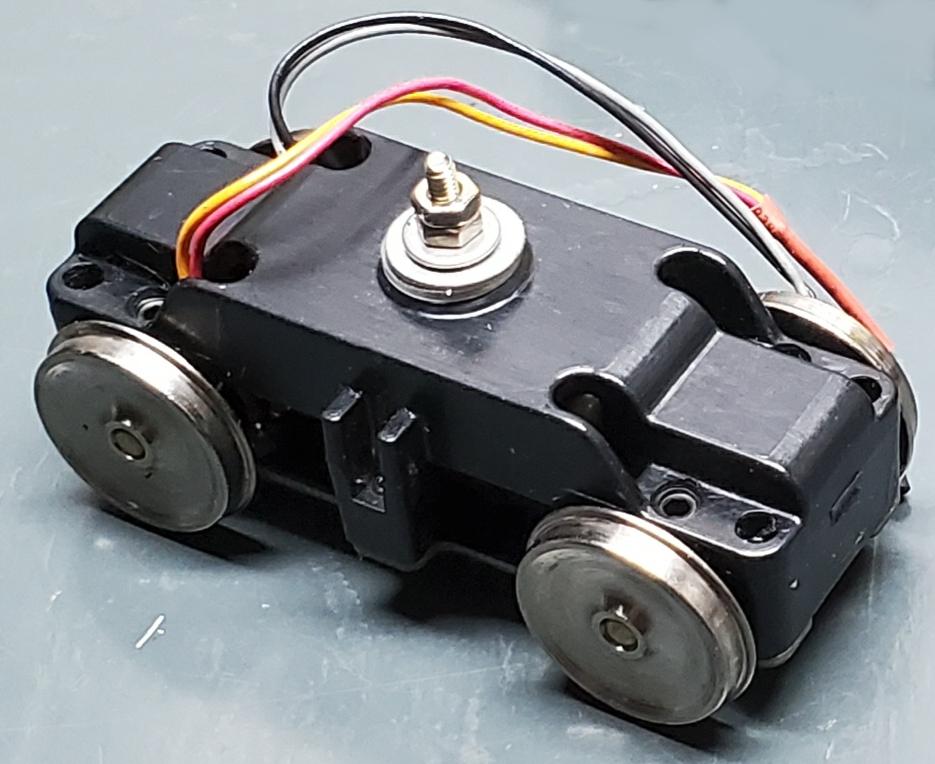
(photo © John Degnan)
The S-scale versions are available in the following configurations (these are made when ordered, so allow several weeks before delivery):
Wheelbase
Wheel Diameter
Wheel Thickness
9'0"
40"
code 87 (P:64 or fine scale)
9'0"
40"
code 110 (scale)
9'0"
36"
code 87 (P:64 or fine scale)
9'0"
36"
code 110 (scale)
9'0"
33"
code 87 (P:64 or fine scale)
9'0"
33"
code 110 (scale)
8'6"
40"
code 87 (P:64 or fine scale)
8'6"
40"
code 110 (scale)
8'6"
36"
code 87 (P:64 or fine scale)
8'6"
36"
code 110 (scale)
8'6"
33"
code 87 (P:64 or fine scale)
8'6"
33"
code 110 (scale)
8'0"
40"
code 87 (P:64 or fine scale)
8'0"
40"
code 110 (scale)
8'0"
36"
code 87 (P:64 or fine scale)
8'0"
36"
code 110 (scale)
8'0"
33"
code 87 (P:64 or fine scale)
8'0"
33"
code 110 (scale)
Jim King, of Smoky Mountain Model Works, was a big force behind getting these drives made fit for S-scale. His smaller switcher engines required these, and so he was able to work with NWSL to get them to produce them. Having handled hundreds of these drives, Jim provides some insight into using them that may help you. By the way, Jim King also produces sideframes, for locomotives, that are designed for the Stanton Drives.
The entire first run of the drives that Jim ordered from NWSL had to be returned, because the majority didn't run at all while some just sputtered, then quit. The entire run was repaired and sent back to Jim, but he still experienced a few issues with them. Most of those came back OK, but he still had to work on several before final shipping of his kits.
Apparently, the common denominator between HO and S trucks is the lubrication NWSL used (likely in the O trucks, too). The previous NWSL owner never changed the lube. Jim talked to his local Hobbytown USA owner who specialized in R/C planes and cars. He suggested washing out the thicker grease, and replacing it with Trinity Royal Oil bearing lube. The label says "super light weight low drag oil formulated for use on motor and axle ball bearings". Jim found that to be the solution.
If you are having problems getting/keeping Stanton trucks running, here's what Jim did to get his trucks running before shipping them to his customers. Connect the power leads to the truck off of a test track so power can get to the motor directly from the power supply. Turn the truck upside-down. If it won't run at all, runs in one direction only, or sputters, increase the power to 12 volts DC and switch the direction switch back and forth to break the motor loose. Once you get it running, reduce voltage until it barely turns and slowly add a few drops of the bearing oil to each geared axle. Let it run in for a minute or so and slowly reduce power until it stops. Reverse direction and slowly increase voltage. If the lube does its job, you should see steadier, slower operation with the truck. Add a couple more drops to each axle gear and run the truck in each direction for at least two minutes. Make sure wheels are clean (he found many of his Stanton drives had dirty wheels), place the truck on powered track and run it back and forth.
Jim believes that, overall, the Stanton drive is a good one for under-the-frame applications in small engines and will run well once the factory-applied grease is removed. The bearing oil stays thin regardless of climate or storage time.